QStory has built a reputation as the contact center workforce management (WFM) platform that puts agents first. The UK-based vendor combines intraday automation with agent self-service, giving frontline staff direct control over voluntary time off (VTO), shift swaps, and activity preferences. Frost & Sullivan recognized the approach twice: a 2021 Product Leadership Award and a 2025 European Enabling Technology Leadership Award in the WFM category.
That recognition has put QStory on shortlists across Europe, the Middle East, and Africa (EMEA), with customers like Nationwide Building Society, Jet2, and eBay running it in production. Recognition and production readiness are different things, though. WFM teams evaluating QStory need to understand where it excels, where it encounters friction, and how it compares to alternatives that take a broader platform approach.
What is QStory?
QStory is a cloud-native WFM platform for contact centers, founded in 2016 and headquartered in London. CEO and co-founder Fiona Coleman built the company around a specific thesis: agent empowerment and operational efficiency reinforce each other.
The platform started as an intraday automation layer designed to sit on top of existing WFM systems. QStory filled the gap between the schedule and what actually happened during the day, complementing existing scheduling and forecasting tools. Automated VTO distribution, break optimization, and activity rescheduling ran in real time while agents received offers through a self-service interface.
QStory has since expanded into full WFM. The platform now includes forecasting, schedule creation, and optimization alongside its original intraday capabilities. That shift positions QStory as a standalone WFM system.
The company employs approximately 26 people and generates roughly $5.7M in annual revenue, according to Serchen's vendor profile. It operates with a cloud-native, API-first architecture that reflects its 2016 founding.
Key features
QStory's capabilities span intraday automation, agent self-service, forecasting, scheduling, real-time management, and back-office WFM. Here is what each module delivers.
Intraday automation
QStory automates the continuous cycle of intraday adjustment that typically requires dedicated real-time analysts. The platform monitors automatic call distribution (ACD) queues and agent states in real time, then generates and distributes offers automatically based on current conditions.
Core automation includes VTO distribution, overtime offers, break optimization, and activity rescheduling. When demand surges hit, QStory triggers skill-based rebalancing across queues to maintain service levels. When demand drops, it converts idle time into productive activities like training or coaching sessions.
The automation runs against real-time condition thresholds. Adjustments happen as conditions change, so the system acts before an analyst would typically notice a variance.
Agent self-service
Agent self-service is QStory's strongest differentiator and the capability most often cited in customer feedback. The model presents options to agents instead of dictating changes from the top down.
Agents see their schedules with flexibility windows and can select from available activities: VTO offers, shift swaps, training slots, and break preferences. A mobile app extends this access beyond the desktop, though the app's Apple App Store rating of 1.9 out of 5 (based on eight reviews) suggests the mobile experience has room to improve.
The distinction matters operationally. QStory presents options and lets agents select within the boundaries the WFM team has defined. That model distributes schedule decisions to agents, which has direct implications for schedule adherence and retention.
Forecasting and scheduling
QStory offers omnichannel demand forecasting and optimized schedule creation across voice, chat, email, and other contact channels. The scheduling engine identifies idle time in generated schedules and converts it to training, coaching, and one-on-one sessions.
These capabilities are newer additions to the platform. QStory built its reputation on intraday automation and expanded into forecasting and scheduling as it moved toward becoming a full WFM suite. Teams evaluating QStory as a complete WFM replacement should assess forecast model sophistication and accuracy against their specific volume patterns.
Real-time management and analytics
The platform provides real-time adherence tracking alongside intraday performance dashboards covering service level, occupancy, and staffing variance at 15-minute intervals. Supervisors can monitor automation effectiveness metrics to see which intraday adjustments are producing results and which need tuning.
Agent engagement analytics track how agents interact with the self-service features, providing visibility into adoption rates and preference patterns across the workforce.
Back-office workforce management
QStory extends WFM principles beyond the contact center into back-office functions. This includes work item management and task prioritization for teams processing claims, applications, or other queue-based work. The module applies the same forecasting and scheduling logic to back-office workflows where arrival patterns and processing times are measurable.
Customers
QStory's sweet spot is mid-to-large contact centers running between 200 and 2,000 agents, primarily in the UK and EMEA. The typical QStory customer is a contact center operation where European labor regulation compliance is a qualifying requirement and where agent engagement ranks alongside operational efficiency as a strategic priority.
The platform attracts organizations that have outgrown manual intraday processes but want to avoid the full complexity of enterprise WFM deployments. These tend to be teams with dedicated WFM functions running omnichannel operations across voice, chat, and email.
Notable customers include Nationwide Building Society, Jet2, and eBay. Lisa Strudwick, Workforce Performance and Productivity Manager at Nationwide, has highlighted the flexibility and autonomy the platform provides to agents and team leaders. Lauren Box, Senior Service Performance Manager at Jet2, has pointed to time savings from automating intraday adjustments that previously required manual intervention by the planning team.
The customer profile across these deployments is consistent: mid-to-large UK-based contact centers that were spending significant analyst time on intraday adjustments and wanted to improve agent experience simultaneously. QStory and eBay were Highly Commended at the 2025 European Contact Centre and Customer Service Awards for Most Effective Improvement Initiative.
Use cases
QStory performs best in three specific scenarios that reflect its founding thesis and product evolution.
Agent empowerment sets it apart
The self-service model is QStory's clearest competitive advantage. QStory treats agents as participants in the optimization process, giving them ownership over schedule decisions within defined boundaries.
Agents choose whether to accept VTO offers, select preferred activities during low-volume periods, and set break preferences within defined windows. The WFM team sets the boundaries. Agents operate within them. This creates ownership over the schedule and reduces passive compliance.
For teams struggling with attrition driven by rigid scheduling, this approach addresses a root cause. Frost & Sullivan's 2025 award specifically cited QStory's agent empowerment capabilities as a differentiating factor.
Intraday responsiveness without analyst overhead
QStory automates the work that many contact centers still assign to dedicated real-time analysts: monitoring queues, identifying variances, and manually adjusting schedules throughout the day. The platform handles this cycle continuously and proactively.
Lauren Box at Jet2 has described the time savings from automating intraday adjustments that previously required manual intervention by the planning team. For mid-sized operations that lack the headcount for a dedicated real-time team, this automation fills a staffing gap.
European compliance by design
Working Time Directive compliance and EU labor regulation handling are built into QStory's scheduling rules at the architecture level. Break requirements, maximum shift lengths, and rest period calculations run as constraints within the scheduling engine.
For EMEA-based operations, this eliminates the compliance configuration burden that teams face when adapting US-built WFM platforms to European labor law.
QStory pricing
QStory does not publish pricing on its website. Getting a quote requires requesting a demo, which is standard for WFM vendors but limits upfront evaluation for teams comparing multiple options.
G2 reviewers have flagged cost as a concern, with at least one reviewer describing the platform as "expensive." The pricing model appears to be per-agent, with specifics depending on which modules are selected and the size of the deployment.
For market context, QStory generally positions below full-suite enterprise vendors like NICE and Verint in per-agent cost. WFM Labs notes a "generally lower per-agent cost" compared to Intradiem, QStory's most direct competitor in the intraday automation space. Cost positioning between QStory and lightweight WFM tools varies depending on deployment scope.
Total cost of ownership extends beyond the per-agent license. Implementation effort, integration configuration, ongoing support costs, and whether QStory replaces your existing WFM or layers on top of it all affect the real number. Teams using QStory as an intraday layer alongside a separate WFM system are paying for two platforms.
Where teams encounter friction
Every WFM platform involves tradeoffs. QStory's strengths in agent self-service and intraday automation come with limitations that matter depending on your scale, geography, and operational requirements.
Scale and enterprise readiness
QStory operates with approximately 26 employees and $5.7M in revenue. Deployments are optimized for the 200-to-2,000-agent range where the platform's automation and self-service capabilities deliver the most value.
Enterprises running 5,000 or more agents across multiple sites and regions may find that QStory's capacity for edge-case handling, custom workflow requirements, and multi-tenant complexity does not match what larger WFM vendors have built over two decades. This reflects company maturity and scale. The practical impact is the same for teams that need enterprise-grade edge-case handling today.
Limited North American presence
QStory's primary market traction is in EMEA. North American operations evaluating QStory should assess three factors: support availability across US time zones, the maturity of US labor regulation handling compared to European compliance, and the availability of local implementation partners.
A UK-headquartered team of 26 serving a global customer base means that Americas-based teams may encounter response time gaps during their operating hours. For contact centers running 24/7 across US time zones, this is a practical consideration.
No business process outsourcing (BPO) vendor management
QStory does not offer unified visibility across internal and outsourced agents. Organizations managing BPO relationships lack consolidated reporting, billing reconciliation, and vendor performance tracking within the platform.
For teams where BPO management is a qualifying criterion, this is a gap that requires a separate solution. Manual reporting and spreadsheet-based billing reconciliation persist for outsourced agent populations, even as internal agent management runs through QStory's automation.
Forecasting maturity
QStory's expansion from intraday automation into full WFM means that forecasting is a newer part of the platform. The intraday engine has years of production refinement behind it. The forecasting models have less.
Teams evaluating QStory as a complete WFM replacement should run forecast accuracy tests against their own historical data and compare results with purpose-built forecasting engines. The question is whether QStory's forecasting meets your accuracy requirements today, given that the capability is still maturing.
Reporting and mobile experience gaps
G2 reviewers have noted wanting more productivity reporting from the platform. Analytics cover intraday performance adequately but may not satisfy enterprise requirements for custom reporting, executive dashboards, or cross-functional visibility.
The agent mobile app carries a 1.9 out of 5 rating on the Apple App Store based on eight reviews. For a platform built around agent self-service, mobile experience quality directly affects adoption. With only nine G2 reviews total, peer validation for evaluators is also limited compared to established vendors with hundreds of reviews.
Alternatives to QStory
QStory competes in a market that spans dedicated intraday automation tools, full-suite enterprise WFM platforms, and unified modern WFM systems. Where you look depends on which QStory tradeoff matters most for your operation.
Intradiem is QStory's most direct competitor in intraday automation. Intradiem offers a deeper automation rules engine, broader integrations, and stronger enterprise-scale traction, particularly in North America. It comes at a higher price point and takes a more top-down approach to automation compared to QStory's agent self-service model.
NICE, Verint, and Aspect represent the full-suite enterprise WFM tier. These platforms handle the widest range of WFM requirements across scale, geography, and complexity. They also carry the most implementation overhead, the highest costs, and accumulated architectural complexity from decades of acquisitions and feature expansion.
Assembled takes a different approach: a unified WFM platform that combines scheduling, forecasting, intraday management, real-time adherence, and BPO vendor management in a single system. For teams that identified BPO visibility, forecasting maturity, or North American support as friction points with QStory, Assembled addresses those gaps without requiring multiple layered tools.
How QStory compares to Assembled
The comparison reflects two different approaches to WFM: QStory's intraday-first, agent-empowerment focus versus Assembled's unified platform covering the full WFM lifecycle.
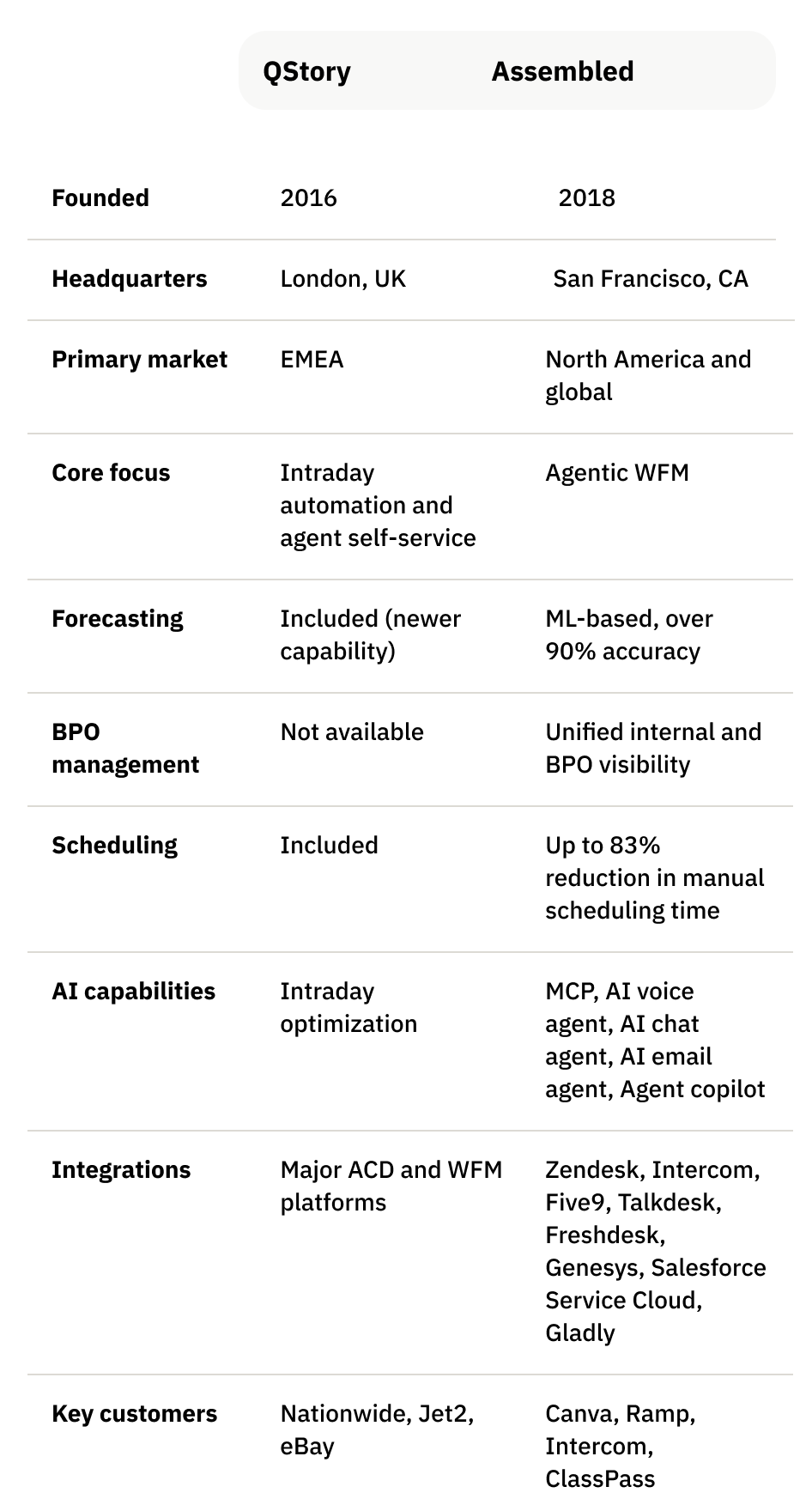
Three differences stand out for teams weighing these options.
Unified platform eliminates tool layering. Assembled was designed as a unified platform with scheduling, forecasting, intraday management, and real-time adherence integrated from the start. For teams that want scheduling, forecasting, intraday management, and real-time adherence in one system, Assembled removes the need to maintain separate tools.
BPO vendor management fills a structural gap. Assembled provides unified visibility across internal and outsourced agents, including consolidated reporting and billing reconciliation. QStory does not offer BPO management. For operations running a mix of internal and outsourced agents, this is a qualifying difference.
Machine learning forecasting with demonstrated accuracy. Assembled's forecasting engine delivers over 90% accuracy using models that update dynamically. For teams where forecast precision drives staffing costs and service level outcomes, demonstrated accuracy metrics reduce evaluation risk.
Conclusion
QStory is a credible option for EMEA-based contact centers with 200 to 2,000 agents that prioritize agent empowerment alongside operational efficiency. The self-service model is genuinely differentiated, Frost & Sullivan recognition validates the approach, and the intraday automation reduces reliance on dedicated real-time analysts.
The friction points are real. Limited scale beyond 2,000 agents, no BPO vendor management, a primarily EMEA presence, and newer forecasting capabilities all narrow the fit. Teams should weigh these tradeoffs against their specific requirements.
For teams that need unified WFM with BPO visibility, machine learning-based forecasting with demonstrated accuracy, or North America-based support, Assembled provides these capabilities in a single platform. Tour the product to see how Assembled handles the full WFM lifecycle.
FAQ
Is QStory a full WFM replacement or an add-on?
QStory has expanded from an intraday automation layer into a full WFM suite with forecasting and scheduling. Whether it replaces your existing WFM system depends on your requirements around forecast complexity, reporting depth, and integration needs. Teams with straightforward forecasting requirements and mid-sized agent populations may find it sufficient as a standalone platform. Teams with complex multi-site operations or advanced forecasting needs should evaluate it against purpose-built full-suite WFM tools.
Does QStory work for North American contact centers?
QStory's primary market is EMEA, and its European labor regulation compliance is more mature than its US equivalent. North American operations should evaluate support availability during US business hours, the depth of US labor regulation handling, and whether local implementation partners are available in their region before committing. The 26-person team is headquartered in London, which affects response times for Americas-based support requests.
How does QStory handle BPO and outsourced agents?
QStory does not currently offer BPO vendor management. Organizations managing outsourced agent populations alongside internal teams will need a separate solution for unified visibility, billing reconciliation, and vendor performance tracking. This is a qualifying consideration for operations where BPO management drives a significant portion of WFM complexity.
What integrations does QStory support?
QStory integrates with major ACD and WFM platforms. The integration ecosystem covers the primary contact center platforms but is narrower than established vendors with decades of partner development. Verify that your specific tech stack is supported before beginning evaluation, and ask about the configuration effort required for your ACD and CRM combination.
How does QStory compare to Intradiem?
Both QStory and Intradiem focus on intraday automation for contact centers. QStory differentiates through agent self-service and European compliance. Intradiem offers a deeper automation rules engine, broader integration coverage, and stronger enterprise-scale traction, particularly in North America. Intradiem typically comes at a higher price point. The choice depends on whether agent empowerment or automation depth is the higher priority for your operation.