Customer support is in the middle of a major transformation. Teams are moving past chatbots and IVRs toward AI agents that promise faster resolutions and more natural experiences. Sierra AI has quickly become one of the most visible players in this shift — but its approach reflects a familiar pattern: treating AI as a point solution rather than as part of the broader support operation.
By focusing narrowly on autonomous agents, Sierra positions automation as a quick fix, while leaving out the deeper workforce orchestration and human–AI collaboration that enterprise teams depend on. The result is a tool that can look impressive in demos but often struggles to connect AI outcomes with staffing plans, agent enablement, and long-term ROI.
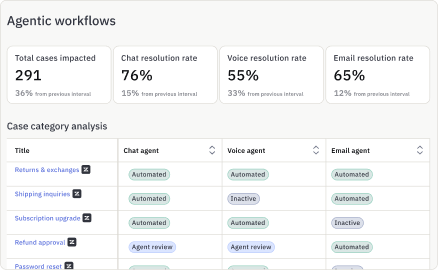
Assembled takes a different approach. Rather than treating automation as a standalone product, it connects AI to the entire support operation — giving leaders full visibility across human agents, AI, and BPO partners. The result is a smarter, human-in-the-loop approach that delivers both immediate efficiency and sustained quality.
What is Sierra AI?
Sierra AI is a customer service automation company founded by Bret Taylor (former Salesforce co-CEO and current OpenAI board chair) and Clay Bavor (former Google Labs executive). The company positions itself as an “AI platform for better customer experiences,” with a particular focus on creating empathetic, autonomous agents that handle routine support interactions at scale.
Funding and growth
Sierra has quickly become one of the most high-profile startups in the AI support space, raising $175 million at a $4.5 billion valuation. Backed by its leadership pedigree and investor confidence, Sierra has secured partnerships with recognizable consumer brands across industries.
Positioning in the market
Sierra emphasizes three main pillars in its value proposition:
- Empathetic conversations — AI responses that feel more natural and human.
- Autonomous resolution — shifting most interactions away from human agents.
- Enterprise scale — targeting large consumer-facing brands with high support volumes.
Reported results
Sierra AI highlights customer results such as:
- 4.5/5 CSAT across customer engagements.
- Up to 90% resolution rates on transactional, repeatable workflows.
But despite strong numbers in demos and narrow use cases, many enterprise leaders say the automation-heavy approach leaves critical gaps in areas like workforce management, agent collaboration, and operational visibility. These gaps make it difficult to capture long-term ROI, even if short-term CSAT or resolution rates appear strong.
Key features and capabilities of Sierra AI
Sierra positions itself as a platform for building autonomous customer support agents that balance empathy with automation. Its offering centers on four main pillars:
1. Improve experiences
Sierra’s AI agents are designed to solve customer problems in real time, with:
- Contextual reasoning for more natural, human-like interactions.
- Empathetic conversation models that move beyond simple scripts.
- Omnichannel support across email, chat, and voice, with particular strength in voice.
2. Deploy quickly
The platform promotes rapid setup and iteration through:
- A no-code agent builder for simple workflows.
- A developer toolkit (Agent Studio) for deeper customization.
3. Partner for success
Sierra emphasizes collaboration in rollout and adoption, including:
- Outcome-based pricing, where customers pay when AI creates measurable value.
- Tailored onboarding programs.
- Supported deployments with Sierra’s services team.
4. Scale with trust
The company positions compliance and oversight as core differentiators, such as:
- Guardrails and supervisor controls to manage agent behavior.
- Data privacy, governance, and security practices aligned with enterprise needs.
- Built-in audit tools and feedback loops for ongoing monitoring.
Common use cases for Sierra AI
Sierra positions its AI agents as versatile tools that engage customers “in the moments that matter,” with a focus on handling high-volume, repeatable inquiries before expanding into more complex workflows. Sierra AI highlights five core categories of use cases:
Pre-purchase
- Product recommendations
- Eligibility checks
- Availability and promotions
- Cross-sell and upsell opportunities
Orders
- Returns and exchanges
- Cancel or track orders
- Delivery scheduling and driver support
Account updates
- Billing issues and charge inquiries
- Payment management (make or change payments)
- Unsubscribe requests
Troubleshooting
- Device setup and configuration
- Error code handling
- Connectivity problems
- App crashes and loading errors
Subscriptions
- Manage subscription and billing changes
- Save or process cancellations
- Apply promotions or rewards
- Redeem loyalty points
Case studies
Sierra promotes its traction through recognizable customer brands, including:
- CLEAR: Leveraged Sierra for proactive engagement and retention use cases, achieving a 4.7/5 CSAT. (CLEAR also uses Assembled for workforce management.)
- ADT: Enhanced scaled care, helping customers with peace of mind in security use cases.
- SiriusXM: Enabled customers to make payments, manage accounts, and perform technical refreshes through chat.
- Sonos: Accelerated onboarding and troubleshooting, reducing time-to-music for device setup and issue resolution.
Where Sierra AI falls short for enterprise support teams
While Sierra has brand recognition and early traction, independent reviews highlight several shortcomings in real-world enterprise environments:
No agent copilot
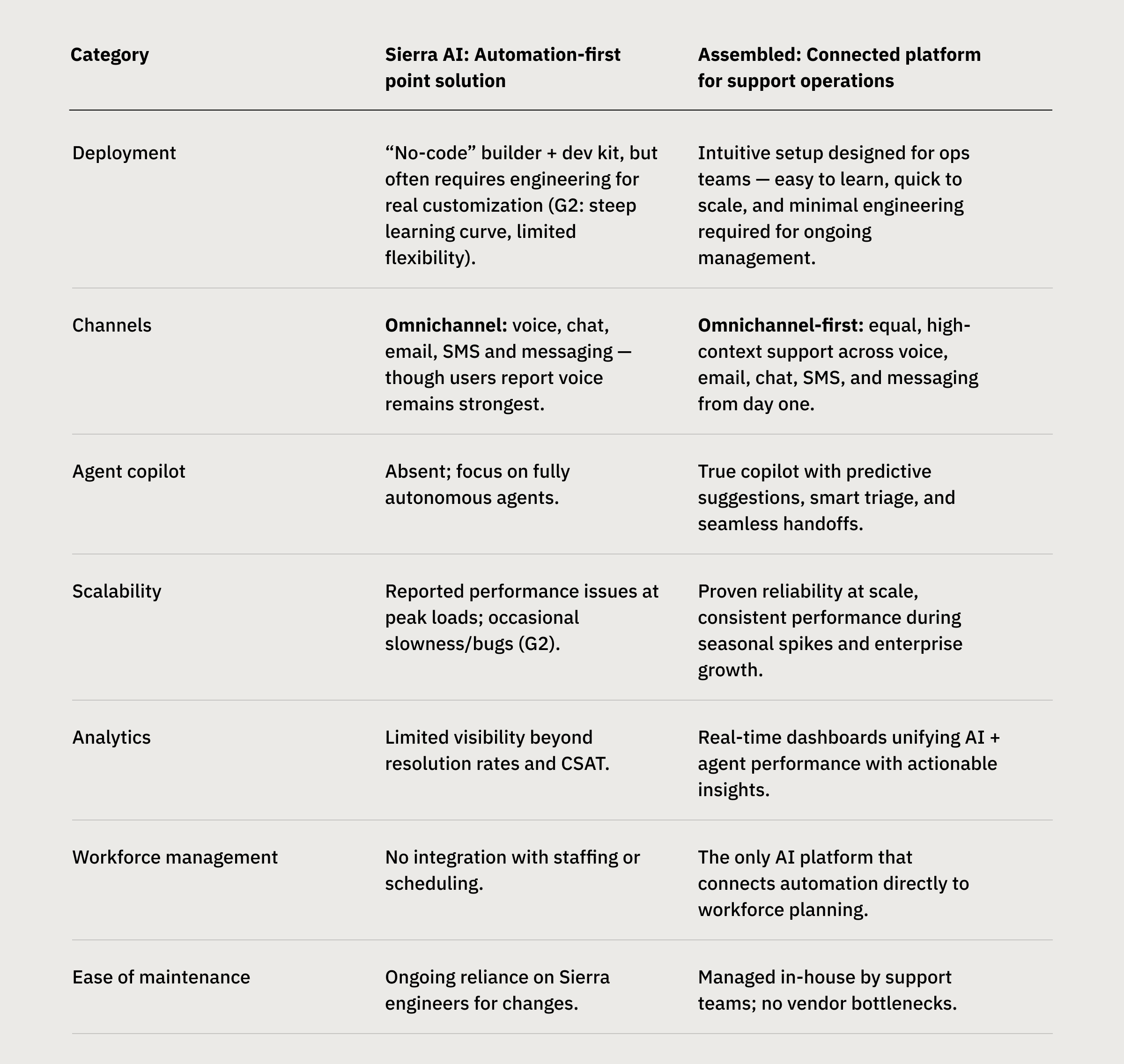
Sierra markets autonomous agents but doesn’t offer real agent-assist capabilities. There’s no predictive guidance, real-time knowledge surfacing, or collaborative case handling — leaving frontline agents on their own for complex issues. By contrast, Assembled delivers a true copilot with suggested next actions, smart triage, and seamless human-AI handoffs.
Heavy engineering lift
Despite its “no-code” promise, enterprise teams report Sierra deployments require significant engineering input. Setup can stretch from weeks to months, and even small workflow changes may require rebuilds. As one G2 reviewer put it: “Sierra’s UI can sometimes be overwhelming or not intuitive for new users. It may require a steep learning curve to navigate effectively, which can hinder productivity initially.” Others note it “does not allow for client customization as competitors,” adding delays and complexity. By comparison, Assembled is designed for support teams to self-manage, adapting workflows without waiting on engineers.
Scalability concerns
Maintaining consistent performance during seasonal spikes or high volumes remains a challenge. Independent comparisons point to latency and responsiveness issues — echoed by customer reviews noting: “The platform can be slow at times, and there are occasional bugs that need fixing.” Assembled is engineered to deliver reliable, low-latency performance at enterprise scale, ensuring that even during demand surges, operations run smoothly without degradation.
Gaps in workforce management
Perhaps the biggest concern: Sierra doesn’t connect automation to staffing or workforce planning. That means leaders are left guessing how AI volume impacts human workload — making it difficult to staff accurately or measure ROI. There’s no adaptive scheduling, intraday forecasting, or performance optimization to balance the mix of AI and human agents.
Assembled closes this gap by tying AI strategy directly to workforce management. Our platform helps you understand AI workload capacity in real time and automatically adjust human staffing to match — ensuring maximum cost efficiency and maximum customer happiness. Instead of automation running in a silo, AI is orchestrated alongside people and BPO partners, so leaders can finally capture the full ROI of their investments.
Not omnichannel-first
Sierra is strongest in voice. But reviewers point out that chat and email lag — with weaker context retention and slower responsiveness compared to voice. Assembled is omnichannel by design, enriching cases with context across every channel for consistent, data-rich experiences.
Inconsistent customer support
Even when Sierra provides onboarding and service support, G2 reviews caution that “the quality and responsiveness of customer service may vary.” For enterprise teams running mission-critical operations, that unpredictability is a risk. By contrast, Assembled is praised for its hands-on, responsive support.
Sierra AI pricing
Sierra does not publish pricing details on its website, which makes cost evaluation less transparent for prospective customers. The company is known to use an outcome-based pricing model, where businesses pay when Sierra creates measurable value.
On the surface, this approach sounds attractive because costs align with results. But in practice, outcome-based pricing introduces challenges for many teams:
- Hard to forecast costs — unpredictable support volumes make budgeting difficult.
- Demand spikes — costs can escalate quickly during seasonal peaks or unexpected surges.
- Complex negotiations — outcome-based terms usually require custom contracts, adding friction and slowing time-to-value.
- Variable ROI — if Sierra struggles with context or resolution quality (as some G2 reviews note), leaders may still be billed for interactions that don’t actually reduce downstream workload.
For support teams managing large budgets and mission-critical operations, the unpredictability of Sierra’s model can feel risky. By contrast, Assembled offers transparent, scalable pricing designed to give leaders predictability without hidden complexity.
Alternatives to Sierra AI for customer service solutions
Sierra AI has momentum as an automation-first point solution, but reviews and real-world adoption suggest its narrow focus creates long-term challenges. Without ties to workforce planning, AI initiatives often become disconnected from staffing, agent collaboration, and ROI capture. G2 reviewers also point to issues like steep learning curves, lack of customization, and inconsistent support — signals that Sierra’s model may be harder to operationalize than it looks in demos.
Assembled offers a different path. Rather than treating automation as a standalone product, Assembled integrates AI directly into workforce operations. That means:
- Orchestration across every resource — leaders can run human agents, AI agents, and BPO partners as one coordinated system.
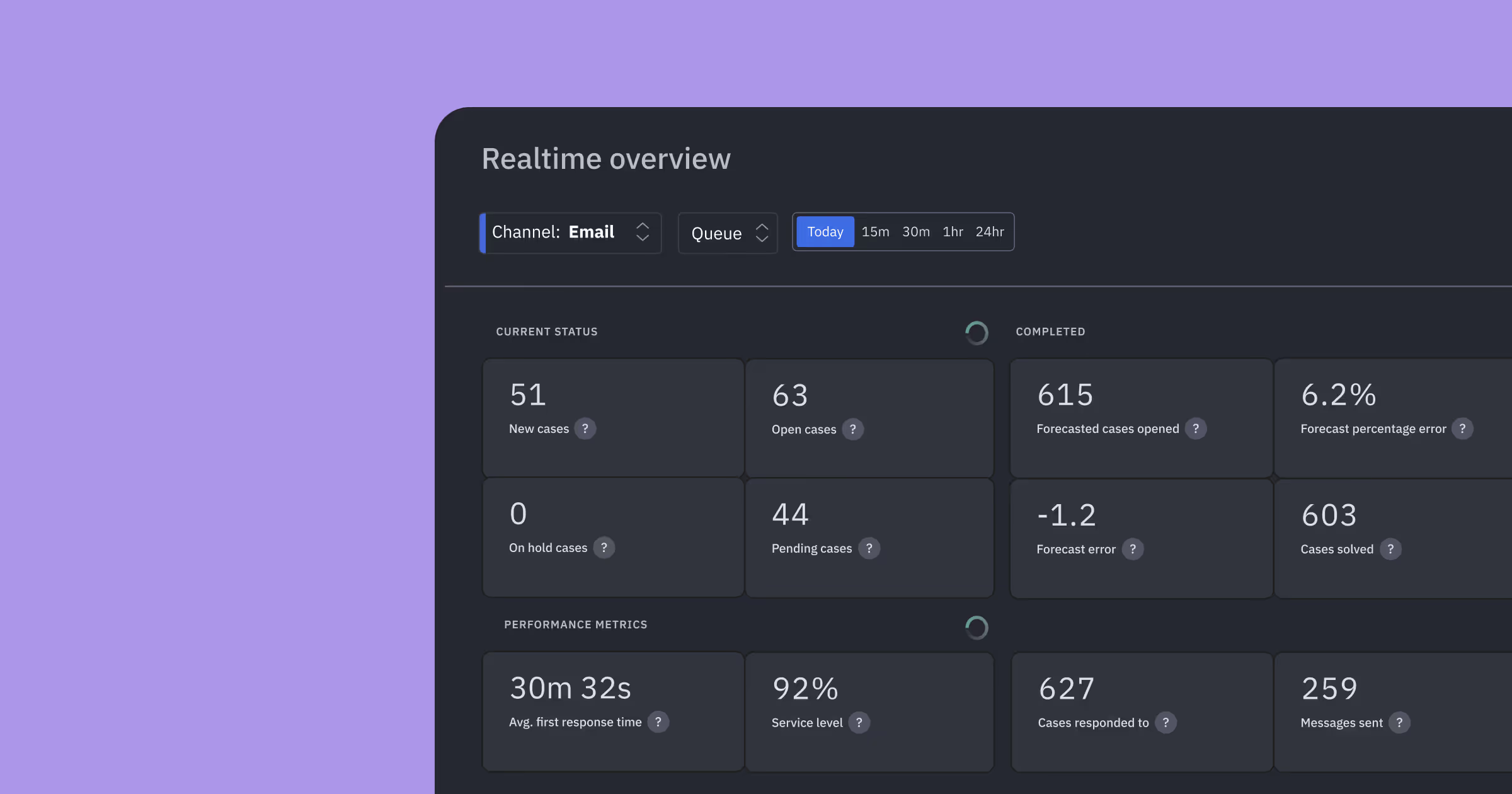
- Operational visibility — real-time dashboards connect performance across people and AI, so efficiency gains are measurable.
- Scalability and adaptability — built to handle seasonal peaks and enterprise growth without the latency, bugs, or responsiveness issues customers report with Sierra.
The result: AI that actually strengthens your workforce strategy, instead of running parallel to it.
Sierra AI vs. Assembled
Improve your support operations with Assembled
As customer expectations rise, automation alone isn’t enough. Support leaders need solutions that combine AI with the people, processes, and visibility that keep operations running. That’s exactly what Assembled delivers:
- Fast to deploy — stand up AI without heavy engineering lift.
- Omnichannel by design — consistent, context-rich experiences across voice, email, and chat.
- Enterprise scalability — reliable performance even at seasonal peaks.
- Actionable analytics — real-time dashboards spanning AI and human agents.
- Ease of ownership — built for support teams to manage directly, without vendor bottlenecks.
Stop wrestling with AI point solutions. Connect automation to your workforce strategy with Assembled.