Most customers can spot a chatbot from a mile away — and they're tired of them. Rigid menus, dead ends, and "I didn't quite get that" loops aren't just frustrating; they're expensive. They push more work onto agents and erode trust in self-service.
But intelligent virtual assistants are different. They don't deflect problems — they resolve them. They understand context, take action across systems, and elevate your agents instead of competing with them. For support teams trying to level up both efficiency and experience, IVAs are quickly becoming the standard.
What is an intelligent virtual assistant
An intelligent virtual assistant (IVA) is AI-powered software that understands and responds to complex user requests in a human-like, conversational manner. Unlike basic chatbots that follow predefined scripts, IVAs use natural language processing (NLP) and machine learning to interpret context, personalize responses, and learn over time.
You've likely encountered consumer IVAs like Siri, Alexa, or Google Assistant. In customer support, though, intelligent virtual assistants do something more valuable. They don't just answer questions. They resolve issues end-to-end — processing refunds, updating accounts, checking order status — without creating a ticket or putting someone on hold.
What makes an IVA "intelligent" comes down to four core capabilities:
- Human-like conversation: Understands natural speech, handles interruptions, and responds conversationally
- Context awareness: Remembers previous interactions and personalizes responses based on customer history
- Continuous learning: Improves accuracy over time through machine learning, without manual updates
- Action execution: Completes tasks like processing refunds or updating accounts, not just providing information
The result? Support that feels less like automation and more like partnership.
Intelligent virtual assistant vs chatbot
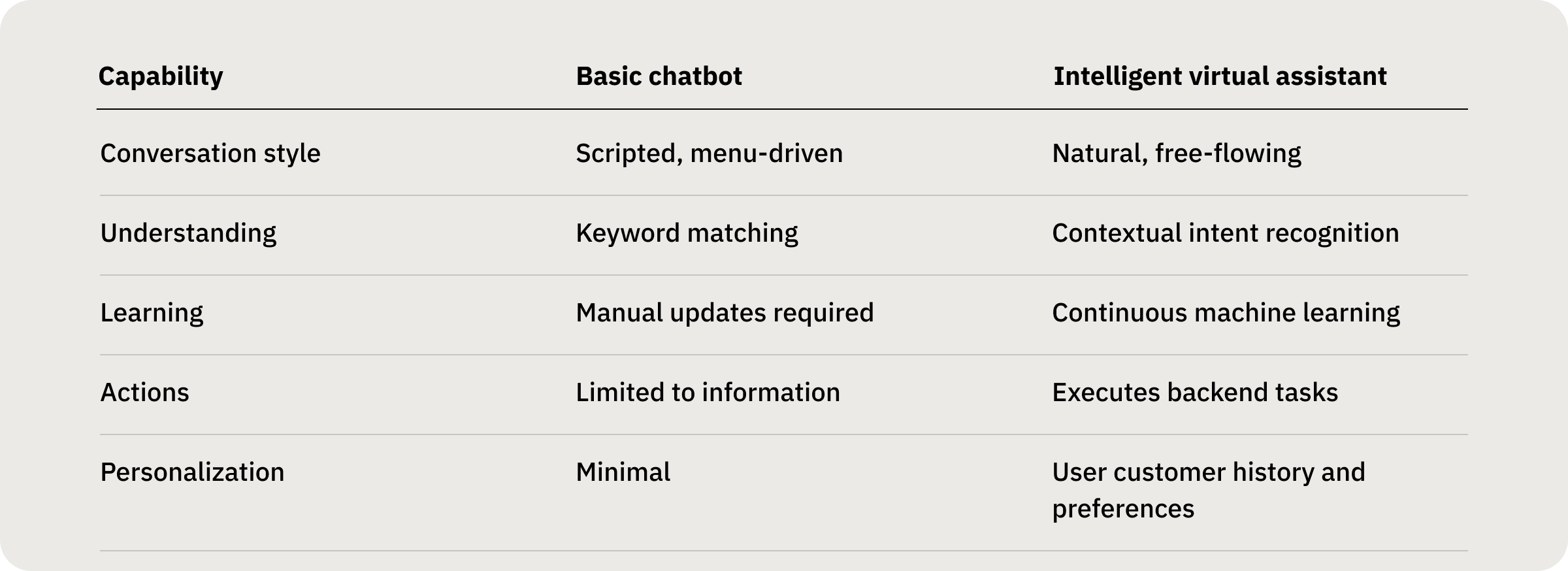
Not all automated support tools work the same way. The distinction between a basic chatbot and an intelligent virtual assistant matters when customer satisfaction — and your team's sanity — is on the line.
How IVAs communicate with customers
Chatbots follow rigid scripts and decision trees. If a customer phrases something unexpectedly, the bot often gets stuck or loops back to the beginning. (You know the feeling.)
IVAs understand natural language. They handle interruptions, topic shifts, and follow-up questions without missing a beat. When a customer says "actually, wait, I also wanted to ask about my refund," an IVA adjusts. A chatbot typically can't.
How IVAs retrieve and deliver answers
Chatbots match keywords to predetermined responses. If the right keyword isn't there, the response won't be either.
IVAs use semantic search, which means they understand meaning, not just words. They pull from knowledge bases, past tickets, and backend systems to find accurate answers. Even better, they take action directly: processing a return, updating an address, or checking order status without creating a ticket.
That's the difference between deflection and resolution.
How IVAs learn and improve over time
Chatbots require manual updates whenever something changes. New product? Someone has to add it to the script.
IVAs learn from outcomes and feedback. They refine responses automatically, getting better at recognizing intent and resolving issues over time. No one has to rebuild the decision tree every quarter.
How intelligent virtual assistants work
Understanding what's happening under the hood helps when evaluating solutions. Here's how modern IVAs process and respond to customer requests.
Natural language processing and understanding
NLP converts human speech or text into structured data that the system can interpret. It handles accents, background noise (for voice), typos, and colloquial language — the messy reality of how people actually communicate.
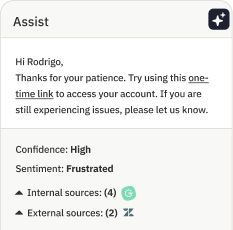
Sentiment analysis adds another layer by detecting frustration or urgency from tone. When a customer sounds upset, the IVA can adjust its approach or escalate faster. That matters more than most vendors admit.
Intent recognition and smart routing
Intent recognition identifies what the customer actually wants to accomplish, not just what words they used. "Where's my stuff?" and "Can you track my order?" mean the same thing. A good IVA knows that.
The system then classifies requests and routes them to the right workflow or human agent. Modern IVAs assess both what customers say and how they say it — because context changes everything.
Backend integrations and workflow execution
Backend integrations separate resolution from deflection. IVAs connect to CRMs, order systems, and ticketing platforms to take real action:
- Check order status
- Process refunds
- Update account information
- Schedule appointments
- Create and route tickets with full context
Without integrations, an IVA can only answer questions. With them, it actually solves problems. That's the difference between a tool that looks good in demos and one that transforms your operations.
Response generation and brand voice alignment
IVAs generate responses dynamically rather than pulling from scripts. But that doesn't mean they sound generic. The best platforms let teams define brand voice in plain language, so every response feels consistent with your company's tone — whether that's warm and conversational or direct and professional.
Empathy matters here. Customers can tell when they're getting canned responses versus something that actually acknowledges their situation. The right IVA maintains your brand's humanity at scale.
Where intelligent virtual agents are used in customer support
Customers reach out through multiple channels and expect consistent experiences across all of them. The best intelligent virtual agents work across every channel from a single platform — because fragmented tools create fragmented experiences.
Voice and phone support
Phone support is traditionally the most expensive channel to staff. IVAs handle calls end-to-end or gather context before handoff, reducing handle time and improving the customer experience.
Capabilities like interruption handling, natural conversation flow, and real-time transcription make voice IVAs feel less like phone trees and more like actual conversations. Your customers notice the difference immediately.
Live chat and messaging
Chat is the fastest-growing support channel. IVAs provide instant responses without wait times and handle multiple conversations simultaneously — something human agents can't do.
The key is making sure those instant responses actually resolve issues, not just buy time.
Email automation
IVAs draft responses, auto-reply to common requests, and triage incoming messages. Context from email threads carries over if a customer switches channels later — no more "let me pull up your account" delays.
Help centers and self-service portals
IVAs power intelligent search and guided troubleshooting within help centers. Customers can resolve issues without initiating a conversation at all. When self-service actually works, everyone wins.
Benefits of an intelligent digital assistant for support teams
The outcomes that matter to support leaders go beyond "automation." Here's what actually changes when an IVA works well.
Faster resolution and higher customer satisfaction
IVAs resolve requests in real time without hold times or ticket queues. Natural, personalized conversations improve customer experience compared to menu-driven IVR or scripted bots.
Speed matters. But speed with resolution matters more.
Reduced operational costs at scale
Handle volume increases without proportional headcount growth. Sustainable scaling doesn't break your budget or your team. That's not just efficiency — it's survival in a world where support volume keeps climbing.
Improved agent productivity and performance metrics
Agents receive pre-gathered context and suggested responses. Repetitive tasks get automated, freeing agents for complex issues that actually benefit from human judgment.
AI copilot functionality takes this further by assisting agents in real time with relevant knowledge articles and next-best-action recommendations. The result? Agents spend less time searching and more time solving.
Consistent global support around the clock
IVAs don't have shifts. They provide the same quality at 3 a.m. as 3 p.m. Multilingual capabilities enable global coverage without staffing every timezone or compromising on quality.
Lower agent burnout and turnover
Automating repetitive, draining work improves agent job satisfaction. Agents handle more interesting, complex cases that use their skills. They're not stuck resetting passwords for eight hours straight.
Making support work sustainable matters as much as making it efficient. Burnout isn't just a people problem — it's an operational one.
The role of intelligent virtual assistants in collaboration with human agents
IVAs work best as teammates, not replacements. The goal is augmentation — making human agents more effective, not obsolete.
We believe exceptional support requires both: AI that handles what it does best, and humans who bring judgment, empathy, and creativity to the moments that need it most.
Intelligent handoffs with full context
When escalation is needed, the IVA transfers the full conversation history, customer data, and case classification. No more customers repeating themselves. No more agents starting from scratch.
Adjustable handoff sensitivity lets teams account for customer sentiment or request complexity. Some situations warrant faster escalation than others. The system should be smart enough to know the difference.
AI copilot capabilities for live agents
IVAs assist agents during conversations with suggested responses, relevant knowledge articles, and next-best-action recommendations. Agents stay in control while AI handles research and drafting.
It's like having a senior agent whispering helpful suggestions in real time — without the awkwardness.
Unified context across every channel
When a customer moves from chat to phone to email, their history follows them. Both IVA and human agents see the same unified view. A platform approach makes unified context possible; point solutions don't.
That's why we built Assembled as a unified platform — because fragmented tools create fragmented experiences, and your customers deserve better.
What to look for in an intelligent assistant
Evaluating IVA solutions comes down to a few key criteria. Here's what separates tools that actually help from tools that just look good in demos.
Omnichannel support from a single platform
Avoid solutions that only cover one channel. You'll end up with fragmented data and inconsistent experiences. Look for unified automation engines that power voice, chat, email, and self-service from one system.
Assembled AI operates across chat, email, voice, SMS, Slack, and help centers — all from a single platform. That's not a feature. It's a requirement.
Resolution metrics vs deflection metrics
Some IVAs are designed to deflect contacts (containment), others to actually resolve issues. Ask vendors whether they measure success by resolution rate or just containment rate.
The difference matters. Deflection looks good on a dashboard. Resolution changes customer experience.
Deep integrations with your existing tools
The IVA should connect to your CRM, ticketing system, order management, and knowledge base. Without integrations, the IVA can only answer questions. It can't take action.
Assembled integrates seamlessly with the tools your team already uses — Salesforce, Zendesk, Freshdesk, and more. Because automation that doesn't connect to your workflows isn't automation. It's theater.
Brand voice customization and empathy
Responses should sound like your brand, not generic AI. Look for platforms that let you configure tone without requiring technical expertise.
Your brand voice is part of your customer experience. The right IVA maintains it at every touchpoint.
Enterprise reporting and quality assurance
You need visibility into what the IVA is doing, how it's performing, and where it's struggling. QA capabilities let you review conversations and refine the system over time.
Assembled provides enterprise-grade reporting and quality assurance so you can continuously improve — not just set it and forget it.
How to implement an intelligent virtual assistant
Implementation doesn't have to be overwhelming. Modern platforms don't require custom AI expertise or heavy coding. Here's how to get started.
1. Define your automation goals and priority use cases
Start with specific, high-volume use cases where automation will have the most impact. Don't try to automate everything at once. Focus on quick wins first — password resets, order tracking, account updates.
Build momentum, then expand.
2. Connect your CRM, ticketing, and knowledge systems
Integrations are the foundation. Modern platforms offer pre-built connectors for common tools like Salesforce, Zendesk, and Freshdesk. Assembled's seamless integrations mean you're not starting from scratch.
3. Configure workflows and brand voice in plain language
No-code or low-code configuration is now standard. Define how the IVA handles specific scenarios and what tone to use, without writing code. Assembled's customizable workflows let you maintain brand consistency at every customer touchpoint.
4. Test performance against historical tickets
Before going live, run the IVA against past customer inquiries to see how it performs. Testing builds confidence and reveals gaps before customers encounter them.
This step matters more than most teams realize.
5. Launch, monitor, and refine over time
Implementation isn't a one-time event. Use reporting and QA tools to identify improvement opportunities and refine continuously. The best IVAs get better over time — but only if you're paying attention.
Transform your customer support with Assembled IVAs
The shift happening in customer support isn't about replacing humans with AI. It's about enabling better support at scale: faster resolution, more consistent experiences, and sustainable operations.
We believe exceptional customer support should be accessible, consistent, and scalable for every business. By combining advanced AI with seamless workflow automation, we help organizations resolve complex issues efficiently while keeping every interaction true to their brand.
The best solutions unify AI and workforce management so automation and human agents work together seamlessly. Assembled takes this approach — combining intelligent virtual assistants with the tools support teams already use to deliver high-quality, 24/7 support without increasing headcount.
Support is becoming faster, more scalable, and, counterintuitively, more human. When IVAs handle the repetitive work, agents have time for the conversations that actually benefit from empathy and judgment. That's not a trade-off. It's the future.
Ready to see how an intelligent virtual assistant can transform your support operations? Book a demo and discover how Assembled helps teams resolve tickets efficiently while staying true to their brand.
FAQs about intelligent virtual assistants
What is the difference between an intelligent virtual assistant and an intelligent virtual agent?
The terms are often used interchangeably. Both refer to AI-powered software that understands natural language and can take actions on behalf of users. Some vendors use "agent" to emphasize task execution capabilities, but functionally, they describe the same technology.
How much does an intelligent virtual assistant cost for customer support teams?
Pricing varies widely based on conversation volume, channels covered, and feature requirements. Most enterprise IVA platforms use usage-based or tiered subscription models. Request pricing directly from vendors based on your specific volume and use cases. The right question isn't just cost — it's ROI. What does better resolution, lower handle time, and reduced burnout save you?
Can intelligent virtual assistants handle conversations in multiple languages?
Yes, modern IVAs support multilingual capabilities, though the number of languages and quality of understanding vary by platform. Evaluate language support based on your customer base's primary languages and regional dialects. Assembled's multilingual capabilities enable global coverage without compromising quality.
How long does it take to implement an intelligent virtual assistant?
Implementation timelines range from weeks to months, depending on complexity, integrations required, and how many use cases you're automating. Platforms with pre-built connectors and no-code configuration typically enable faster launches. The key is starting with focused use cases and expanding from there.
What metrics should support teams track to measure intelligent virtual assistant performance?
Key metrics include resolution rate (not just containment), customer satisfaction scores, average handle time, escalation rate, and agent productivity. Focus on outcomes that reflect actual issue resolution rather than just interaction volume. Deflection is a vanity metric. Resolution is what matters.