Introducing Schedule Generation: AI-powered scheduling built for modern support orchestration

For teams with hundreds of agents, manual scheduling can consume an entire week every month. That's nearly a quarter of a workforce manager's time spent on repetitive schedule construction instead of strategic workforce planning.
Today, Assembled is introducing Schedule Generation — an AI-powered scheduling engine that uses demand forecasts, business rules, and operational constraints to create optimized agent schedules from scratch. With Schedule Generation, teams are eliminating 95% of manual scheduling time, which can add up to nearly 12 weeks of time gained back in one year, in addition to setting intelligent guardrails that keep all schedules in compliance.
This is more than just faster scheduling, it's the next generation of support operations. Read on to learn how it works, why traditional approaches fail at scale, and what teams are achieving with truly optimized schedules.
The challenge: Manual scheduling doesn't scale
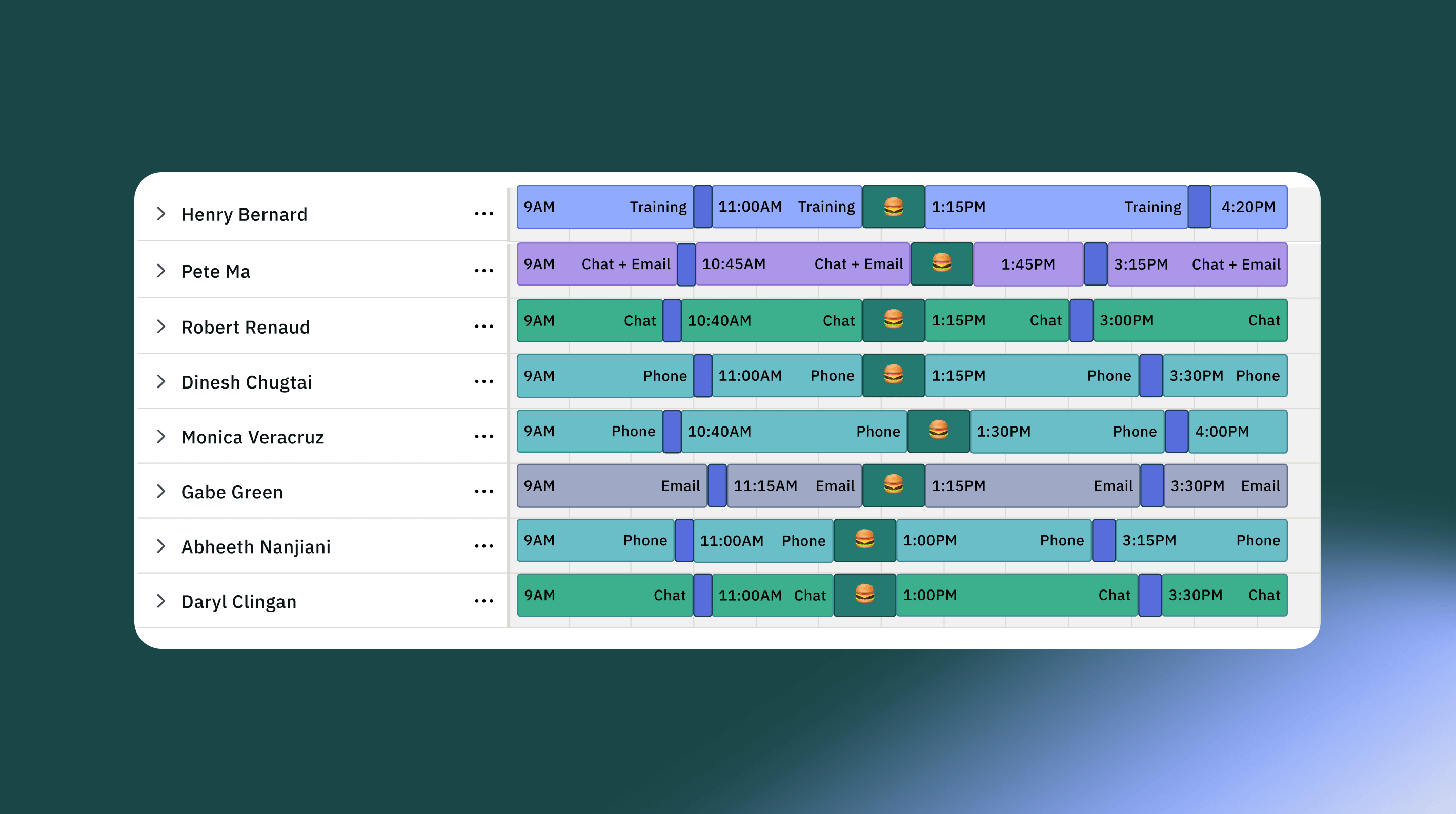
Because workforce managers are stuck spending endless hours on manual work, WFM teams that should be strategic partners end up as scheduling services.
As teams grow, the complexity multiplies. Every new hire, location, or channel makes manual scheduling exponentially harder. Here's why: For a team of 1,000 agents working across a week, you're looking at approximately 10³⁰'⁰⁰⁰ possible schedule combinations. Just writing down the digits of that number would take 15 pages.
This is what computer scientists call an NP-hard problem (short for Nondeterministic Polynomial-time hard problem), where traditional approaches break down completely at scale, especially for teams trying to schedule hundreds of agents.
Legacy WFM tools don't help. They force teams into templates that can't handle modern support operations, like blended workforces, hybrid schedules, multi-channel operations, and varying labor requirements across locations.
Meet the next-gen scheduling engine
Schedule Generation is built for complexity. Under the hood, we use advanced mathematical optimization — the same techniques that route packages for logistics companies and schedule flights for airlines — to generate optimal schedules automatically.
Traditional tools make decisions sequentially, which paints you into a corner. Placing Agent A's lunch at noon might look optimal, but it eliminates valid lunch windows for Agents B and C, creating coverage gaps or compliance violations down the line. Instead, Assembled considers millions of possible schedule combinations simultaneously, finding the optimal solution that maximizes coverage while respecting every constraint.
For customers with tens of thousands of shifts per week, we generate compliant, optimized schedules in minutes rather than hours.
Intelligent scheduling rules that match your reality
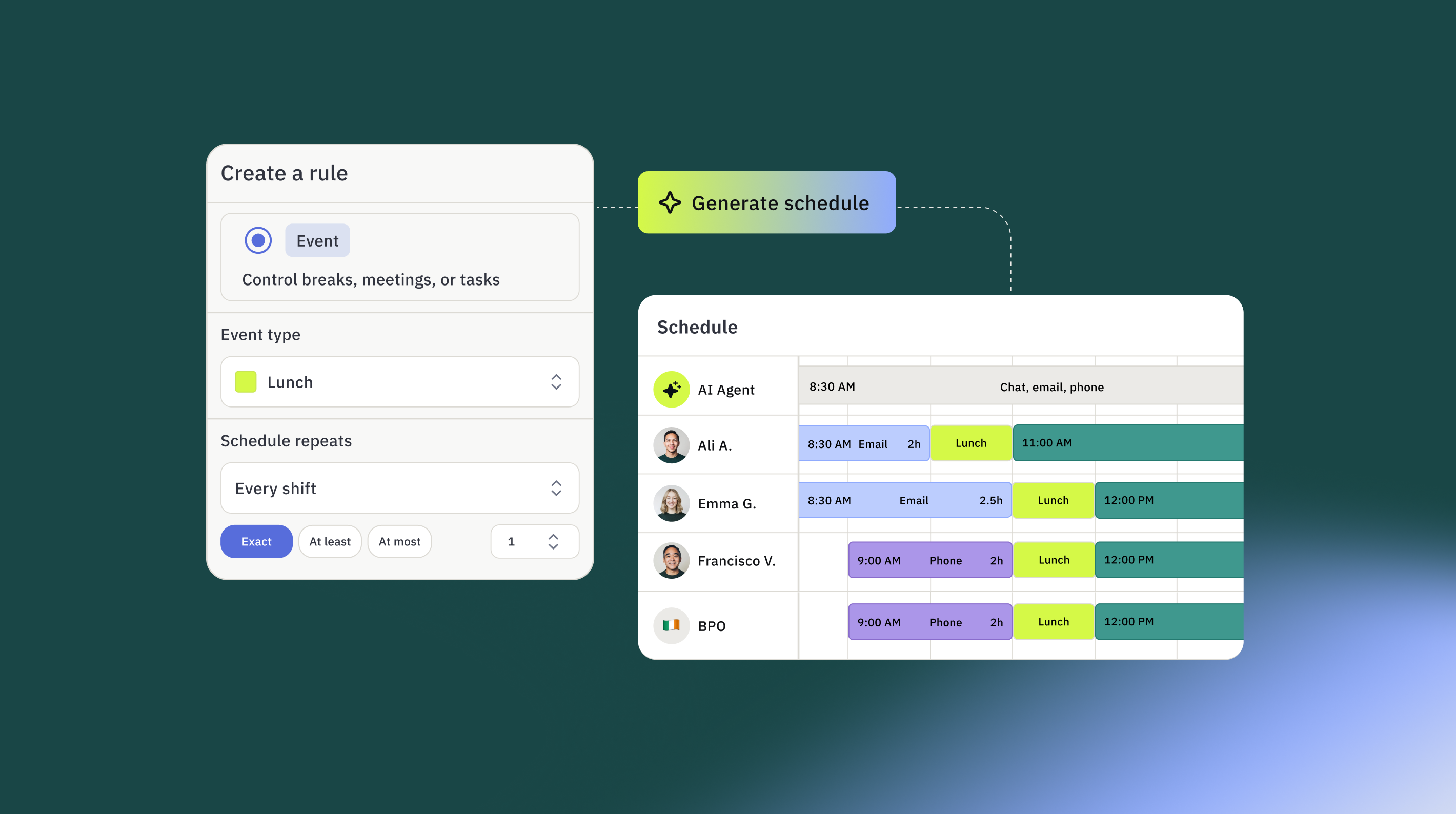
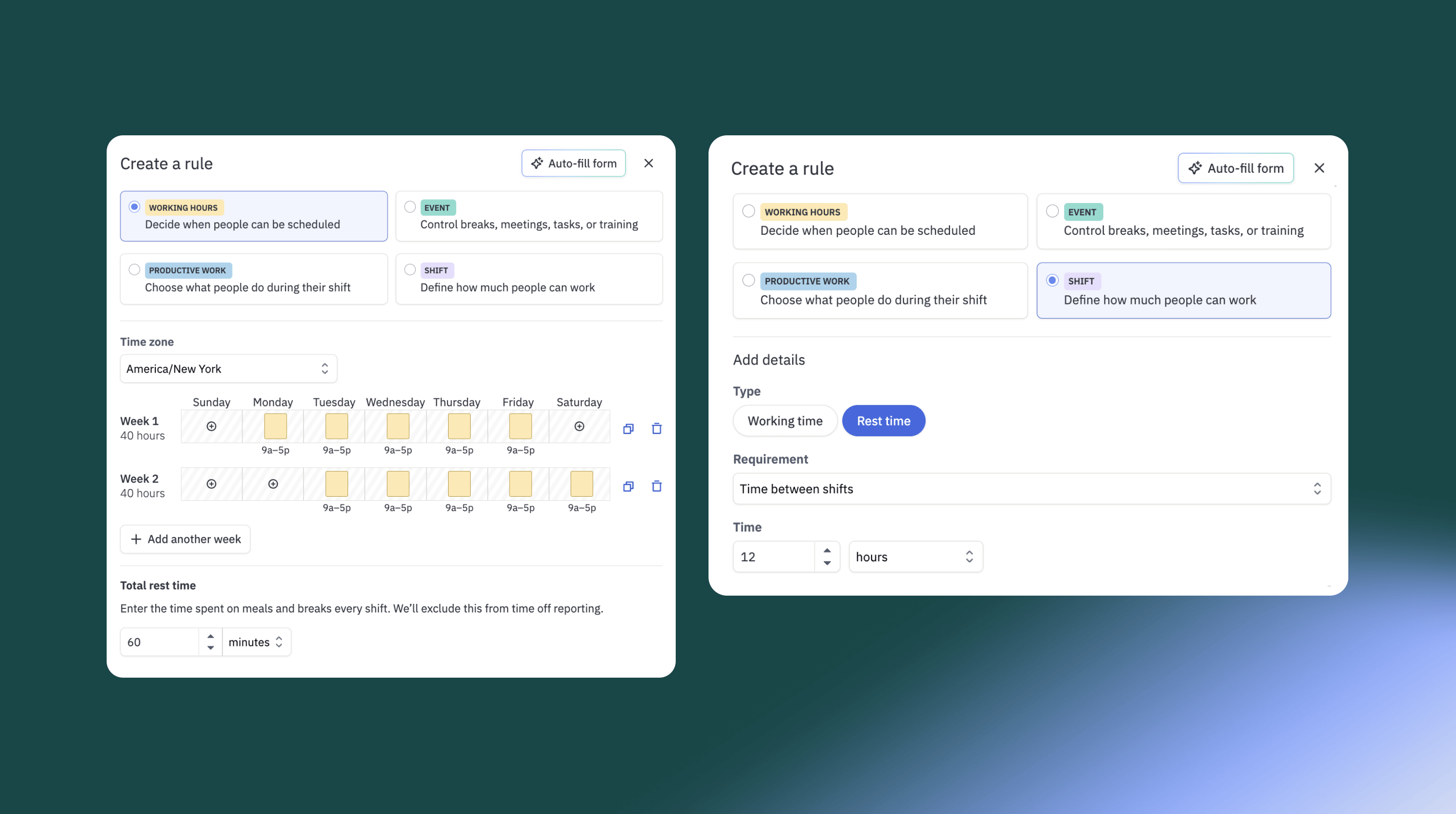
At the heart of Schedule Generation is a flexible rule engine that captures operational requirements without forcing users into rigid templates.
Working hours define when each agent can work, with support for complex patterns: 13-week rotations, cross-midnight shifts, timezone coordination. Users can also upload existing schedules via CSV to get started quickly.
Smart compliance automation handles location-specific constraints, automatically placing breaks and lunches according to local labor laws. Whether you need breaks every 3.5 hours in California or 4 hours in Texas, Schedule Generation ensures automatic adherence.
Productive work rules let you shape how agents spend their day. Rather than simple overrides, these rules guide the optimization: How often should agents switch between email and chat? Should senior agents reserve blocks for escalations? Can phone agents flex to other channels during low-volume periods? Schedule Generation balances these constraints with demand forecasts to create schedules that work for both coverage and agent effectiveness.
Dual-purpose intelligence: Generation and validation
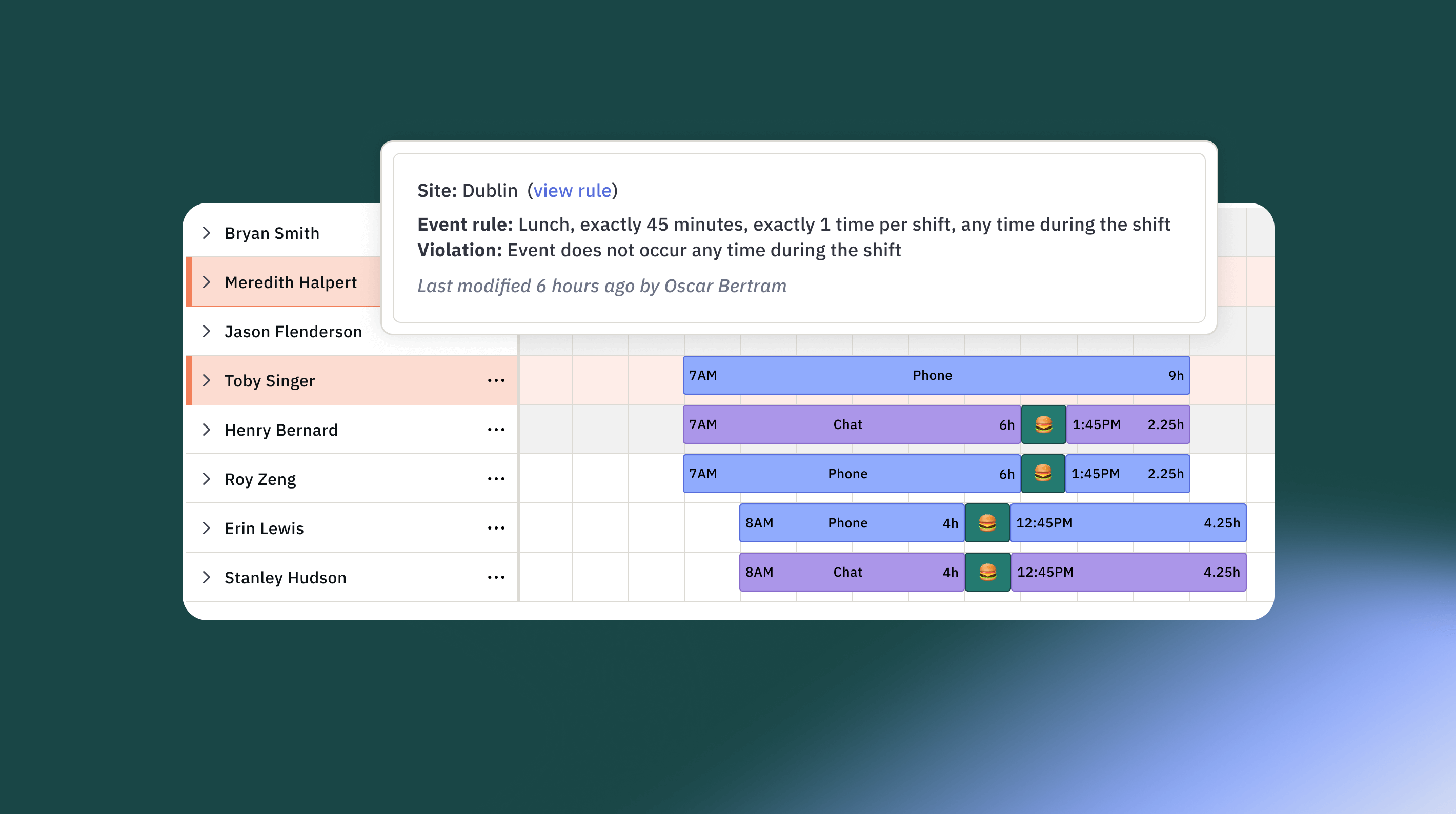
The same rules that generate new schedules actively monitor existing ones for violations.
When you set up a constraint like "15-minute break before the 5th hour of every shift," that rule immediately starts validating your existing schedules in real-time. If someone accidentally schedules an agent outside their working hours or misses a required break, you'll see a warning on the Staffing Timeline.
This means you can confidently make manual overrides when needed, knowing Assembled will flag any compliance issues. And when you're ready to generate a new schedule, those same rules ensure the output is compliant by design.
The rule engine also handles sophisticated patterns that traditional tools can't, like weekly all-hands meetings where every agent attends once but at optimal times based on their coverage needs, or recurring 1-1s scheduled at different times for everyone with no overlaps. These scenarios require modeling direct relationships between shifts, a mathematically complex challenge that Schedule Generation solves automatically.
SLA-driven optimization that handles real complexity
Schedule Generation doesn't just fill shifts — it optimizes for outcomes.
Assembled analyzes your demand forecasts across all channels and queues, considers agent skills and qualifications, and creates schedules that maximize SLA performance while respecting all your business constraints.
Behind the scenes, our mathematical optimization engine makes thousands of interconnected decisions: which agents should work which shifts, which channels they should cover at which times, when to switch between work types to balance coverage and focus time, and how to place breaks and meetings without violating coverage or compliance requirements.
The result: schedules that are provably optimal, not just "good enough."
Schedule Generation handles the complexity that breaks traditional tools: blended phone and email schedules, multi-skilled agents working across queues, 24/7 operations spanning multiple time zones, and seasonal demand fluctuations.
Test, validate, and publish with confidence
Every generated schedule lands in a test environment first, giving you full control before agents see any changes.
Review the schedule, make manual adjustments if needed, and publish selectively — all agents or just a subset. Real-time violation detection means you can spot and fix issues immediately before publishing.
Customers are achieving transformative results
Early users are seeing real impact: scheduling workflows that used to take hours now take minutes, with compliance automatically enforced and violations flagged before publishing. Because schedules are truly optimized (not just valid), teams are hitting SLAs consistently and meeting customer expectations. That saved time is going back into planning, optimization, and strategic work that elevates their entire function.
At Preply, the language learning platform, manual scheduling consumed entire weeks as they grew from 30 to over 200 support agents.
After implementing Schedule Generation, Preply reduced monthly scheduling time from one full week to minutes. The results: 5.8% improvement in team adherence, 60% improvement in average handle time, and consistent 4.4+ CSAT scores despite rapid scaling.
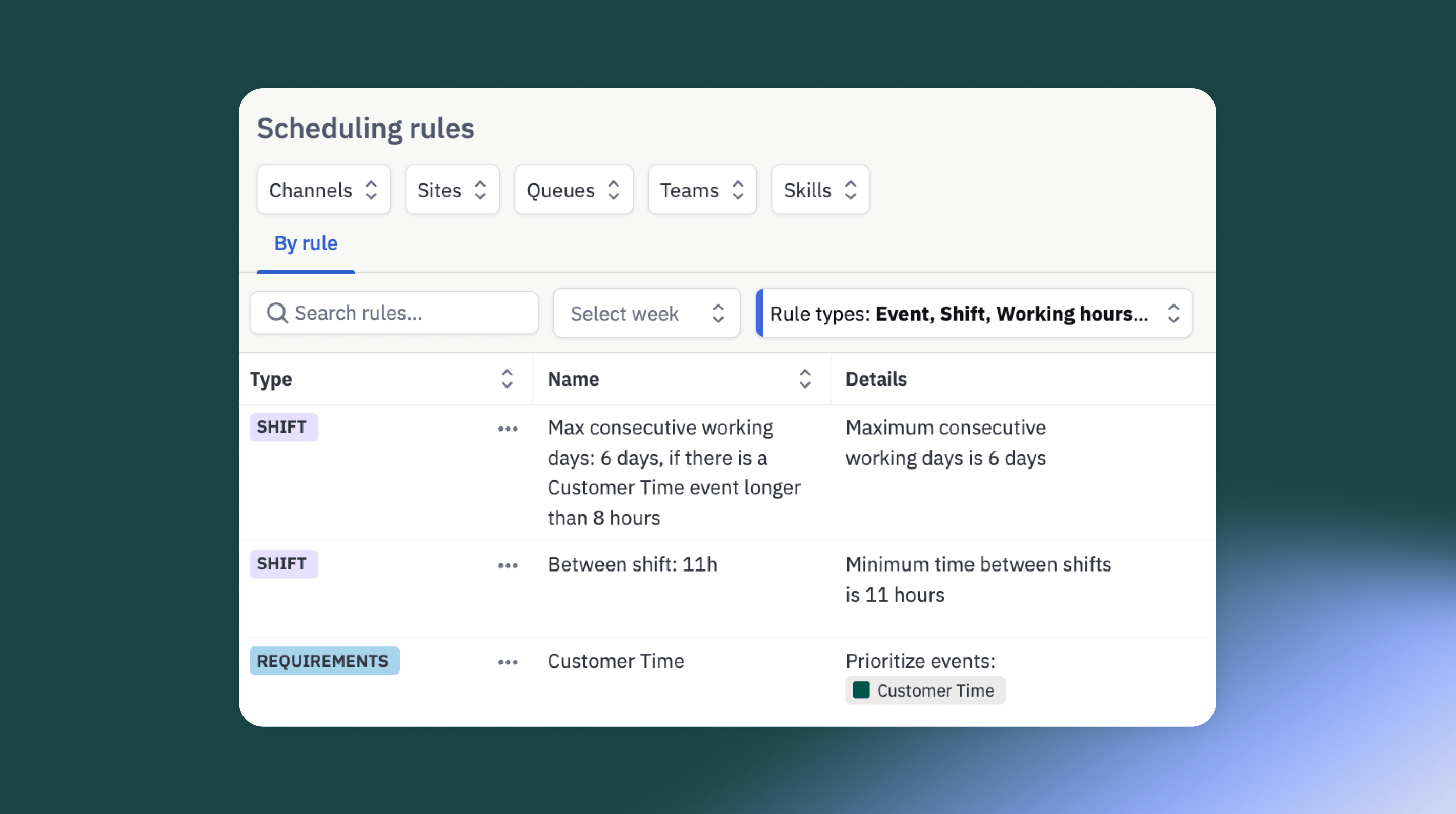
ServiceTitan, a software platform for commercial and home service business, relies on Schedule Generation's intelligent approach to schedule over 300 agents. They’ve got 80 different rules, constraints, and labor laws across 3 different countries:
With Assembled, ServiceTitan has been able to reduce scheduling time by 95% with the confidence that schedules are optimal to meet staffing requirements and are always in compliance.
Early adopters are transforming manual scheduling work into high-value optimization and planning. WFM teams are becoming strategic partners instead of scheduling services.
The bigger picture
Schedule Generation underscores our commitment to building AI-powered workforce management tools for the new reality of modern support operations.
The future of support orchestration is complex: human agents working alongside AI, in-house teams collaborating with BPO partners, hybrid schedules adapting to changing demand. The teams that win will be the ones that embrace this complexity rather than hide from it.
Ready to transform your scheduling process? Explore our interactive demo or chat with our team to see how it works with your specific operational needs.