Calabrio ONE is a workforce engagement management (WEM) suite built for contact centers. The platform bundles workforce management, quality management, analytics, and performance management into a single product. Founded in 2007 and headquartered in Minneapolis, Calabrio has grown to serve millions of agents across 73 countries through more than 300 partner relationships.
The platform targets mid-market and enterprise contact centers, typically ranging from 100 to 50,000 agents. Calabrio positions itself as a unified solution for organizations that want WFM, quality monitoring, and analytics on a single platform rather than stitching together point solutions. It ranks among the top workforce optimization software tools in the category, with a core value proposition centered on eliminating the data silos and workflow fragmentation that come from running separate systems.
In April 2026, Verint absorbed Calabrio following Thoma Bravo's approximately $2 billion acquisition. The Calabrio brand now appears under Verint's umbrella on review platforms like Gartner Peer Insights and G2. This ownership change follows a pattern in the WFM space where private equity consolidation reshapes vendor options.
On G2, Calabrio holds a 4.5 out of 5 rating based on 381 reviews. Capterra users rate it similarly at 4.5 out of 5 across 263 reviews. These scores reflect a mature platform with a substantial user base, though the recent acquisition raises questions about product direction that prospective buyers should weigh carefully during evaluation.
Calabrio's core capabilities
Calabrio ONE bundles four functional areas into a single platform: workforce management, quality management, conversation analytics, and performance management. Here's how each module works in practice.
Forecasting and scheduling
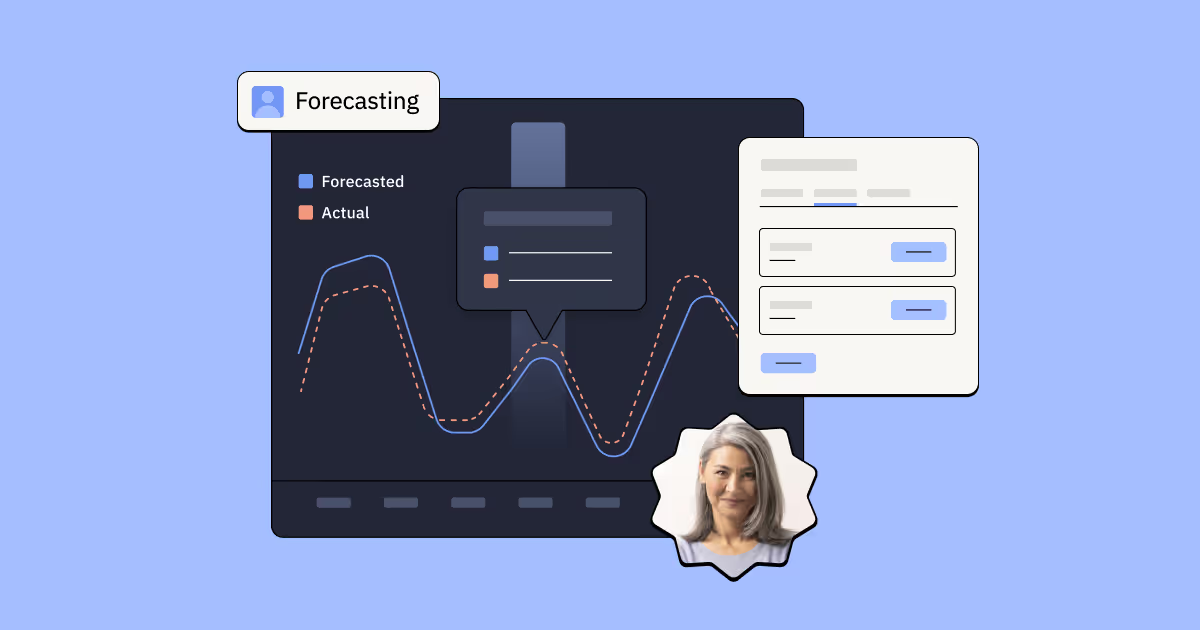
Calabrio uses AI and machine learning to generate demand forecasts and build schedules. The platform handles multi-skill scheduling across contact centers ranging from 100 to 50,000 agents. Forecast models account for historical patterns, seasonal trends, special events, and promotional campaigns. Schedulers can configure rules for skills, shifts, breaks, and coverage requirements with granular control over how the system optimizes agent assignments.
The forecasting engine analyzes historical interaction data to predict future volume by interval. Teams can layer in known events, adjust for marketing campaigns, and account for seasonal variation. The system generates optimized schedules automatically based on configured business rules, though manual adjustments remain common for teams with complex requirements or unique constraints that the automation does not fully capture.
Real-time adherence and intraday management
The platform provides real-time adherence monitoring with interval-level drill-down. WFM teams can see which agents are in or out of adherence at any given moment and track adherence trends across the day. The interface displays agent states, current activities, and time in state, giving supervisors and WFM analysts visibility into floor activity without walking the contact center.
Intraday views show actual versus planned staffing, allowing operators to identify gaps before they affect service levels. The system sends alerts when adherence falls below configured thresholds, enabling proactive intervention. Teams can reforecast mid-day when volume deviates from plan and adjust schedules to reallocate agents across queues or extend shifts to cover unexpected demand.
Agent self-service and mobile app
Calabrio offers agent self-service capabilities through a mobile app and web portal. Agents can view their schedules, request time off, swap shifts with coworkers, and pick up available overtime. This self-service model shifts routine administrative work away from WFM teams and supervisors, allowing agents to manage their own schedule changes within defined guardrails.
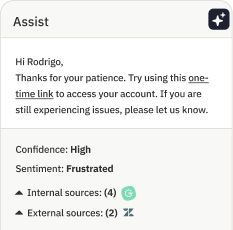
The platform includes Agent Assist, an AI-powered copilot that supports over 50 languages. Agent Assist helps agents navigate scheduling options, understand their adherence status, and complete routine requests without supervisor involvement. Calabrio includes Agent Assist at no additional cost, positioning it as a productivity tool for agents managing schedule changes and routine requests.
Quality management and analytics
The quality management module automatically scores 100% of customer interactions using configurable evaluation criteria. This automated scoring covers voice, chat, email, and other channels, providing consistent evaluation across the full interaction volume rather than the sample-based approach that manual QA requires. Supervisors can review flagged interactions, provide coaching feedback, and track quality trends over time.
Conversation analytics surfaces topics, keywords, and sentiment across interactions. The system identifies common themes in customer conversations, flags emerging issues, and tracks sentiment patterns. Calabrio Insights, the platform's business intelligence layer, provides dashboards and reporting tools for analyzing trends in quality scores, customer sentiment, and operational metrics. Analysts can build custom views and share reports with stakeholders across the organization.
Integrations
Calabrio maintains deep integrations with Genesys Cloud CX, making it a natural fit for Genesys environments. The platform also partners with Twilio Flex and supports connections to other CCaaS platforms. Administrators can configure integrations through self-service tools, reducing reliance on professional services for standard connection setups.
The integration framework pulls data from telephony systems, CRMs, and other contact center tools into Calabrio's unified data model. This centralized data layer enables cross-functional reporting and analytics that span WFM, quality, and customer interaction data. Teams evaluating Calabrio should verify integration depth with their specific platform stack, as the level of native support varies across CCaaS vendors.
Where Calabrio performs best
Calabrio has earned its place in the market for a reason. Here's where the platform consistently delivers.
Forecasting accuracy and scheduling depth
Users consistently praise Calabrio's forecasting and scheduling as robust and accurate. The platform handles complex multi-skill environments and generates schedules that account for business rules, agent preferences, and coverage requirements. G2 reviewers describe the forecasting as reliable, particularly for contact centers with stable, predictable volume patterns.
Teams with straightforward forecasting needs find the automation dependable for day-to-day operations. Those with more complex scenarios appreciate the depth of configuration options available, even when they require time to learn. The scheduling engine can model intricate skill hierarchies, handle multiple sites and time zones, and optimize across constraints that simpler tools cannot represent. For WFM teams coming from spreadsheets or basic scheduling tools, this depth represents a meaningful capability upgrade.
Unified data across WFM, QM, and analytics
Running workforce management, quality management, and analytics on a single platform eliminates the data fragmentation that plagues teams using separate tools. G2 reviewers highlight the seamless data flow between modules as a differentiator. WFM teams can correlate scheduling decisions with quality outcomes. Analysts can pull reports that span adherence, handle time, and customer sentiment without exporting data between systems or reconciling conflicting numbers.
This unified data model matters most for teams that want to answer questions like "How does schedule adherence affect quality scores?" or "Which shifts produce the best customer satisfaction?" Answering these questions with separate tools requires manual data alignment that introduces errors and consumes analyst time. Calabrio's integrated approach handles the data joins automatically.
Agent autonomy and self-service
Capterra reviewers note that agents appreciate the control Calabrio gives them over their schedules. The mobile app lets agents manage shift swaps, time-off requests, and overtime pickups without involving their supervisors directly. This autonomy reduces administrative work for WFM teams and improves agent satisfaction by giving people more control over their work schedules.
The self-service model works best in environments where agents have some flexibility in when they work and management is comfortable delegating schedule decisions within defined boundaries. According to CX Foundation's research on WFM best practices, letting agents choose their own breaks and manage schedule preferences improves both service levels and satisfaction. Contact centers with rigid scheduling requirements or high compliance needs may find less value in these features, but teams that can offer flexibility report that agents engage actively with the self-service tools.
Customer support quality
Calabrio reports a 91% customer satisfaction score for its support organization. G2 reviews describe support as responsive and knowledgeable, with reviewers noting that support teams understand WFM concepts and can troubleshoot operational issues rather than just technical tickets. For teams evaluating WFM platforms, vendor support quality matters because implementation, configuration, and ongoing optimization require vendor collaboration.
A responsive support team reduces the time WFM operators spend troubleshooting issues and waiting for resolution. Teams with limited internal technical resources benefit most from strong vendor support, as they rely more heavily on the vendor for configuration guidance, best practices, and problem resolution.
Where teams encounter friction
Every platform has tradeoffs. These are the patterns that come up most consistently in Calabrio user reviews.
Reporting and analytics complexity
Despite the unified data model, Calabrio's reporting tools draw criticism for complexity. G2 and Capterra reviewers describe Data Explorer as difficult to navigate. Building custom reports requires learning the tool's query structure, understanding data relationships, and mastering the interface conventions. The learning curve can extend weeks or months for analysts who need ad hoc reporting capabilities.
Teams that need quick answers to operational questions often spend more time than expected getting Data Explorer to produce the reports they need. Some users work around the complexity by exporting data to Excel or third-party BI tools, which partially negates the benefit of the unified data model. Organizations planning to use Calabrio's analytics capabilities should budget time for training and expect a ramp-up period before analysts become productive.
Limited real-time integrations
Calabrio supports only one real-time integration at a time. This limitation creates problems for contact centers running multiple platforms simultaneously. One user on a review site described the tradeoff directly: "If you have Amazon Connect and another platform, you get zero real-time data from Amazon Connect."
Teams with complex multi-platform environments may find this constraint forces difficult choices about which data sources get real-time visibility. Modern support operations often span multiple channels handled by different platforms, and the single-integration limit means WFM teams lose visibility into some portion of their operation. For teams evaluating Calabrio, this limitation should be a qualifying question early in the process.
Performance under heavy workloads
Some users report slowness and crashes when working with large datasets or during peak usage periods. Generating reports across long date ranges, running complex forecasts, or having many users access the system simultaneously can strain performance. The interface may lag or time out during these operations.
Teams managing large agent populations or those with demanding reporting requirements should test performance with realistic data volumes during their evaluation. Ask to run reports against your actual historical data during a proof-of-concept, and stress-test the system with the number of concurrent users you expect in production.
Scheduling rigidity and learning curve
Calabrio's "shift bags" feature, which groups shift options for agent selection, can create overwhelming numbers of choices when configured liberally. The intent is flexibility, but in practice, reviewers note that poorly configured shift bags lead to confusion for agents and administrative headaches for WFM teams. Getting the configuration right requires understanding how agents will interact with the options.
Reviewers also note that the overtime and PTO request process requires three manual steps, adding friction to routine workflows that agents and WFM teams execute frequently. New users describe a steep learning curve for scheduling configuration overall. The depth of options that enables complex scheduling scenarios also means more to learn and more opportunity for misconfiguration. Teams transitioning from simpler tools should plan for significant ramp-up time.
Acquisition uncertainty
In April 2026, Verint absorbed Calabrio under a shared Thoma Bravo umbrella. Verint has since outlined a dual-platform strategy, positioning Calabrio for midmarket and Verint for enterprise, with no forced migrations planned. That's a clearer answer than most acquisitions produce this early.
Stated intentions and contractual reality are different things. PE-backed consolidation in the WFM space has a track record: Playvox was acquired by NICE, and product development shifted. NICE has undergone multiple strategic pivots that affected customers. Verint's own 2019 acquisition of Teleopti took years to resolve architecturally, a lesson the combined company has acknowledged.
Buyers evaluating Calabrio should hold Verint to specifics: which features are being cross-pollinated and on what timeline, what happens to existing support and contract terms, and how the midmarket positioning plays out once the integration work gets hard.
Calabrio pricing
Calabrio does not publish pricing. All quotes require direct engagement with sales. Based on available information, baseline pricing starts around $75 per agent per month for the core WFM functionality. Enterprise deals with larger agent counts can negotiate rates as low as $18 per user per month, though specific terms depend on contract length, module selection, and volume commitments.
The full Calabrio ONE suite is available through AWS Marketplace as a bundle, though pricing is contract-dependent and not publicly listed. This bundle includes workforce management, quality management, and analytics. Agent Assist, the AI copilot feature, comes included at no additional charge, which removes a common add-on cost that other vendors charge separately.
Buyers should expect pricing conversations to involve module bundling, multi-year commitments, and volume-based discounts. The lack of transparent pricing makes direct comparisons difficult and extends evaluation timelines. Teams evaluating Calabrio alongside competitors will need to request detailed quotes from each vendor to build accurate total cost of ownership models.
Implementation costs add to the license fees. Complex deployments require professional services for configuration, integration, and training. Teams should request implementation quotes alongside license pricing and clarify what is included in standard onboarding versus what requires additional investment.
Who Calabrio is built for
Calabrio fits best in contact centers with 100 to 5,000 or more agents who want unified workforce engagement management on a single platform. Teams running Genesys Cloud CX benefit from the deep native integration that enables tighter data flow and faster implementation. Organizations with strict compliance requirements, including those needing FedRAMP authorization, find Calabrio's security posture aligned with their needs.
The platform serves teams that value having WFM, quality management, and analytics in one place over best-of-category point solutions. Enterprise contact centers with established WFM practices and dedicated analysts get the most from Calabrio's depth of configuration options. If your team has the expertise to configure complex scheduling rules and build custom reports, Calabrio provides the tools to do so.
Calabrio may be less ideal for teams with omnichannel operations extending beyond voice, those requiring multiple simultaneous real-time integrations, or organizations prioritizing fast implementation. Teams using modern support platforms like Zendesk, Intercom, or Freshdesk may find integration options more limited than with voice-centric CCaaS platforms. Evaluate integration depth carefully before committing.
How Assembled approaches workforce management differently
Assembled builds workforce management specifically for customer support teams. The platform covers scheduling, forecasting, intraday management, and BPO vendor management in a single dashboard designed for how modern support operations work.
Where Calabrio limits teams to one real-time integration at a time, Assembled connects to unlimited platforms simultaneously. Teams running Zendesk for email, Intercom for chat, and Five9 for voice see all channels in one real-time view. This unified visibility matters for support operations where agents handle multiple channels and volume shifts between platforms throughout the day.
The interface reflects how WFM teams actually work. Assembled avoids the legacy complexity that accumulates in platforms built over decades for on-premise contact centers. Scheduling does not require "shift bags" or multi-step manual processes. Operators build and adjust schedules directly, with AI-powered automation handling the optimization while preserving human control over the decisions that matter.
Implementation moves faster than enterprise WFM deployments typically allow. Assembled offers free migrations for teams moving from Calabrio, handling data transfer and configuration without extending the timeline or budget. Teams can be operational in weeks rather than months.
Assembled operates as an independent company focused on workforce management for support teams, with a stable product roadmap driven by customer needs. The company ships updates consistently and maintains a single product focus, which means engineering investment goes directly into the WFM platform rather than being spread across a portfolio of acquired products.
The platform integrates directly with Zendesk, Intercom, Five9, Talkdesk, Freshdesk, Genesys, Salesforce Service Cloud, and Gladly. Beyond WFM, Assembled offers AI Voice, AI Chat, and AI Copilot for teams looking to extend automation into customer- and agent-facing workflows. These AI capabilities connect directly to the WFM platform, enabling coordinated automation across forecasting, scheduling, and agent assistance.
Teams like Platform Science have chosen Assembled over Calabrio. Platform Science's WFM lead had firsthand Calabrio experience and knew it wouldn't meet their needs before evaluation ended. The pattern holds either way: teams with direct exposure to legacy WFM platforms tend to know exactly what they're walking away from.
The bottom line on Calabrio
Calabrio is a mature workforce engagement platform with real strengths. Forecasting and scheduling capabilities satisfy teams with demanding accuracy requirements. The unified data model across WFM, quality management, and analytics eliminates the fragmentation of point solutions. Agent self-service features reduce administrative burden and improve agent satisfaction.
The tradeoffs are real. Reporting tools require significant learning investment before analysts become productive. Real-time integration limits constrain multi-platform environments. Performance issues surface under heavy workloads. The Verint acquisition introduces uncertainty about product direction that buyers should factor into long-term planning.
For WFM teams evaluating their options, Calabrio deserves consideration if the fit criteria align. Teams prioritizing modern architecture, deep real-time visibility across multiple platforms, and stable product direction should also evaluate Assembled.
Request a demo to see how Assembled handles the workflows that matter most to your operation.
FAQs
Is Calabrio the same as Verint now?
In April 2026, Verint acquired Calabrio through Thoma Bravo for approximately $2 billion. The Calabrio brand now appears under Verint on review platforms like G2 and Gartner. Product roadmap and support continuity remain questions for prospective buyers to address directly with sales. Ask about integration plans, platform longevity, and contract terms.
How much does Calabrio cost?
Calabrio does not publish pricing. Baseline estimates start around $75 per agent per month, with enterprise deals negotiating rates as low as $18 per user depending on volume and contract terms. The full Calabrio ONE suite lists at approximately $1,500 per month on AWS Marketplace as a bundle starting point. Agent Assist comes included at no additional cost.
What integrations does Calabrio support?
Calabrio integrates deeply with Genesys Cloud CX and partners with Twilio Flex. The platform connects to other CCaaS platforms through configurable integrations that administrators can set up without professional services. One limitation: only one real-time integration works at a time, which constrains teams running multiple contact center platforms simultaneously.
Is Calabrio good for small support teams?
Calabrio targets mid-market and enterprise contact centers, typically starting at 100 agents. The platform's complexity and pricing structure favor larger operations with dedicated WFM staff. Teams under 100 agents may find the learning curve and cost difficult to justify when simpler, more focused alternatives exist.
What are the best Calabrio alternatives?
Alternatives depend on priorities and team composition. Assembled serves modern support operations with unlimited real-time integrations, fast implementation, and purpose-built design for customer support. NICE and Verint target enterprise contact centers with broad WEM suites and extensive customization. Smaller teams often start with native WFM tools from their helpdesk or CCaaS provider before evaluating dedicated contact center optimization platforms.