Call center voice AI is technology that enables customers to speak naturally with automated systems that understand context, intent, and conversational nuance in real time — without rigid phone menus or keypress inputs. Adoption has accelerated quickly: the global call center AI market — driven largely by conversational AI — was nearly $2 billion in 2024 and is projected to exceed $10 billion by 2032, with overall contact center software spend topping $72 billion in 2025 as organizations prioritize AI-enabled automation and customer engagement.
That growth reflects a major shift from traditional IVR systems that frustrated customers (and made them shout “Representative!” into their phones). Today’s voice AI uses Natural Language Processing (NLP) and machine learning to handle interactions the way a human agent would — by listening, understanding intent, and responding with relevant, contextual help.
It's important to understand this technology and how you can use it to improve customer interactions and call center operations.

What exactly is call center voice AI?
Call center voice AI is an advanced automation technology that uses Natural Language Processing (NLP) and machine learning to understand and respond to customer speech in conversational, human-like interactions — without requiring menu navigation or keypress inputs.
Unlike traditional IVR systems, voice AI doesn't force customers through rigid decision trees. The primary difference is as follows:
Traditional IVR systems rely on pre-recorded scripts and touch-tone responses. A customer hears: “Press one to check your order status. Press two for billing questions.” They press a number and move to the next menu. It's simple in theory, but 52% of professionals say, in their experience, customers still prefer talking to a person.
Modern voice AI understands natural speech, interprets context and intent, and responds dynamically to what customers actually need. It handles the automation — workflows, high call volumes, wait time reduction — while maintaining the personalized feel of speaking with a real agent.
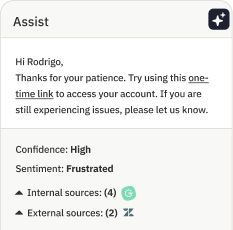
The technology goes beyond basic voice recognition. Today's voice AI systems can analyze customer sentiment, pull relevant information from your systems in real time, and even escalate complex issues to human agents with full context. That means customers get help faster, and your agents handle fewer repetitive requests.
Key voice AI technologies and how they work
Voice AI systems combine three core technologies to understand speech, interpret meaning, and generate appropriate responses. Understanding these components helps you evaluate whether a voice AI solution can handle your call center's complexity.
Automatic speech recognition (ASR)
ASR technology converts spoken words into text that computers can process. Modern ASR goes beyond simple transcription — it handles different accents, background noise, and speaking speeds while maintaining accuracy in real-world call center environments.
Quality ASR is the foundation of effective voice AI. If the system can't accurately capture what customers say, everything downstream fails. Look for solutions with ASR accuracy rates above 95% across your customer demographics.
Natural language understanding (NLU)
NLU technology interprets the meaning and intent behind what customers say. It's the difference between recognizing the words "cancel subscription" and understanding whether the customer wants to cancel immediately, pause temporarily, or explore alternatives.
NLU analyzes context, identifies entities (like account numbers or product names), and determines what action the customer needs. Advanced NLU handles ambiguous requests, follows multi-turn conversations, and adapts to how real customers actually speak — not just scripted phrases.
Speech synthesis and response generation
Speech synthesis converts text-based responses back into natural-sounding speech. Modern text-to-speech technology creates human-like intonation, pacing, and emotion rather than robotic monotone delivery.
The best voice AI combines synthesis with intelligent response generation — pulling information from your knowledge base, applying your brand voice guidelines, and constructing answers that sound natural and helpful. This is what makes AI interactions feel like conversations rather than automated announcements.
How voice AI is improving modern call center operations
Voice AI transforms call center operations by automating high-volume interactions, supporting live agents in real time, and scaling support capacity without proportional staffing increases. Here's how these capabilities play out in practice.
Automating customer interactions
Automation through voice AI reduces agent workload by handling routine interactions independently — freeing your team to focus on complex issues that require human judgment.
When human agents are overwhelmed with inbound calls, everyone suffers. Your agents burn out (a survey found that 28% of agents quit their jobs in 2023 due to burnout), customer engagement drops, and CSAT scores decline. According to Gartner, nearly a third of callers will abandon their service journeys if kept waiting too long.
Voice AI handles the volume by resolving:
- Repetitive tasks like password resets and account verifications
- Basic inquiries about order status or account balances
- Common FAQ questions that don't require specialized knowledge
This means your team manages larger call volumes without adding headcount or creating long wait times. And customers don't mind — 65% of customers say voice AI actually improves their phone interactions.
Providing real-time assistance to agents
Not all voice AI is directly customer-facing. It can be a valuable partner to your human support agents when they handle customer calls.
An AI agent copilot can support your live agents during calls by analyzing the context of the conversation, suggesting relevant solutions, and providing customer data that helps them deliver a more personalized and helpful experience. This type of support has a measurable impact on efficiency, with studies showing that agent after-call work dropped by 35% with the use of AI.
Not to mention that it makes the experience far smoother, easier, and less stressful for your agents. Among companies that don’t use generative AI, 81% of agents were overwhelmed by the information available to them during calls. In comparison, at companies that have deployed generative AI, only 53% of agents reported being overwhelmed.
Enhancing personalization in support
73% of customers expect a personalized customer experience. But you need information — customer data from your CRM, details about previous purchases and interactions, and other customer metrics — to deliver that level of personalization.
Voice AI systems can analyze all of this information in real time and tailor responses based on those individual needs and preferences.
Plus, this technology allows for more proactive customer support too. It can anticipate common issues based on the customer’s profile and suggest solutions without the customer needing to explain their problem from the beginning.
Enabling high-quality, 24/7 support
Nearly half of customers expect 24/7 customer service from businesses, but you likely don’t have enough live agents to satisfy that demand.
Voice AI agents are always available to help customers. Plus, many of these systems offer multilingual service, meaning they can help your customers regardless of their language or location.
Why call center leaders are investing in voice AI now
Call center leaders are investing in voice AI now because three converging factors have made it both necessary and practical: rising customer expectations for instant support, pressure to reduce operational costs without sacrificing quality, and technology maturity that finally delivers on AI's promise.
The market reflects this shift. The voice AI market is growing at a rapid clip, with an expected value of $47.5 billion in 2034 — up from $2.4 billion in 2024. But it's not just hype. Support leaders are seeing specific, measurable benefits that justify moving quickly.
It improves first call resolution (FCR) rates
Voice AI directly improves first call resolution (FCR) — the percentage of customer issues resolved during the initial contact without requiring follow-up. Higher FCR means fewer repeat contacts, lower operational costs, and better customer satisfaction.
Here's how voice AI drives FCR improvement:
- Real-time agent assistance: AI provides live agents with instant insights, suggested responses, and relevant customer data during calls
- Self-service resolution: Voice AI handles common inquiries completely, from account lookups to password resets, without agent involvement
The impact matters. When 65% of consumers say contacting customer service multiple times is the most frustrating issue with businesses, improving FCR isn't just an efficiency metric — it's a loyalty driver. In fact, after more than one bad experience, research shows around 80% of consumers would rather do business with a competitor.

It scales support operations (without increasing headcount)
With cost-cutting still happening in call centers, many leaders are being asked to do more with less. One of the major benefits of voice AI is the ability to scale your support operations without hiring additional agents.
AI voice agents can handle a large volume of calls, address simpler questions, and even assist with call routing for complex escalations — all without putting additional strain on your human agents.
You’ll maintain a high level of service (even during your busiest times) without the added expense and logistical headaches of finding, hiring, and training new agents.
Enterprise voice AI considerations
Enterprise-scale voice AI requires capabilities beyond basic automation — including security protocols, integration architecture, and global deployment support. These considerations determine whether a solution can scale across your organization while meeting compliance and performance requirements.
Security and compliance requirements
Voice AI systems handle sensitive customer data during every interaction. Enterprise-grade security means end-to-end encryption, SOC 2 Type II compliance, GDPR adherence, and role-based access controls that protect customer information while meeting regulatory standards.
For regulated industries like healthcare or financial services, look for voice AI providers with:
- HIPAA compliance for protected health information
- PCI DSS certification for payment card data
- Audit trails that track every AI decision and data access
- Data residency options that keep information in specific geographic regions
Integration complexity and scalability
Voice AI doesn't work in isolation — it needs to connect with your CRM, help desk, telephony system, and other tools in your tech stack. Integration architecture determines how quickly you can deploy and how reliably the system performs at scale.
Evaluate these integration capabilities:
- Pre-built connectors for major platforms (Salesforce, Zendesk, Amazon Connect)
- API flexibility for custom integrations with proprietary systems
- Real-time data synchronization that keeps customer information current
- Scalability to handle peak call volumes without performance degradation
The best enterprise voice AI systems integrate in hours or days, not weeks or months. They also provide monitoring dashboards that show how AI performs across your entire operation.
Global deployment and multilingual capabilities
If you support customers across regions, your voice AI needs to handle multiple languages with the same accuracy and natural conversation quality. Multilingual voice AI goes beyond translation — it understands cultural context, regional expressions, and language-specific nuances.
Key capabilities for global deployment:
- Support for multiple languages with consistent quality across all of them
- Accent recognition that handles regional variations within a language
- Time zone awareness for appropriate greetings and context
- Localized voice options that match your regional brand presence
Enterprise organizations should also verify whether the voice AI can switch languages mid-conversation if a customer prefers to continue in a different language.
Four key features to look for in voice AI tools
The most effective voice AI systems share four essential capabilities that separate reliable automation from frustrating experiences. When evaluating providers, prioritize these features to ensure your investment delivers measurable results.
1. Real-time call transcription and analysis
Look for a system that automatically transcribes and documents your customer interactions.
Beyond basic record-keeping, the system should also analyze those transcripts to uncover trends, understand customer sentiment, and highlight common sticking points. These can help inform your resource planning, training, performance management, and other improvements to your operations.
2. Seamless omnichannel integration
Your voice AI system is obviously focused on phone calls. However, that doesn’t mean this channel should be siloed. Your AI technology should be able to track interactions across channels — like voice, chat, and email — and pull that information into one system to provide a cohesive, omnichannel experience.
Not only does this eliminate the need for customers to repeat themselves, but it also helps your agents gain a broader view of a customer's relationship with the business through omnichannel support.
3. Advanced NLP capabilities
If your voice bots repeatedly go rogue or can’t understand customers, they’ll only be a source of frustration. Your chosen voice AI tool should have advanced NLP capabilities to process varied speech patterns and accurately interpret customer intent.
This means your customers can have more natural, human-like interactions — without getting stuck in an endless call routing cycle or shouting their problem into the phone.
4. Intuitive agent assistance tools
While the customer-facing features matter, don’t forget about your agents. Ensure the system offers agent assistance tools, like predictive analytics and AI copilots that offer real-time support to your human agents.
By suggesting responses, flagging potential issues, and surfacing valuable insights, these features help your agents handle even the most complex situations efficiently and with confidence.
Best practices for implementing voice AI
Successful voice AI implementation requires strategic planning and phased rollout — not treating it as a plug-and-play solution. The goal is to integrate AI where it delivers the highest impact while maintaining agent confidence and customer experience quality.
Here's how to approach implementation:
1. Map workflows for targeted deployment
Identify your highest-volume, most repetitive interactions before deploying AI. Map your current processes to find inefficiencies, then prioritize AI where it can resolve issues independently or accelerate agent work. Targeted implementation maximizes ROI and builds stakeholder confidence through early wins.
2. Invest in team training and change management
Voice AI changes how your agents work. Provide comprehensive training on how AI handles routine requests, when it escalates to humans, and how agents can leverage AI-generated insights during calls. Effective training helps agents see AI as a productivity tool rather than a replacement.
3. Monitor performance and iterate continuously
Track key metrics from day one: resolution rates, customer satisfaction scores, escalation patterns, and agent sentiment. Use this data to refine AI behavior, adjust escalation logic, and identify gaps in your knowledge base. Voice AI improves through continuous optimization, not one-time setup.
4. Start with controlled pilots, then scale
Launch voice AI in a specific queue or use case before expanding across your entire operation. Pilot programs let you test functionality, gather feedback, and build internal expertise without disrupting your full support operation. Once you've proven value and refined the system, scale strategically based on results.
Gain a competitive edge with voice AI for your call center operations
The perception of voice AI as only rigid phone menus and robotic voices is outdated. The technology has improved by leaps and bounds, and it’s well on its way to becoming a staple of the modern call center, with Gartner estimating the share of AI-handled customer interactions is growing to 14% of interactions by 2027.
Ultimately, people don’t have a problem with AI for customer service — they have a problem with bad AI for customer service. And a voice AI agent delivers that natural, conversational, and human touch your customers crave, while your team benefits from the automation, efficiency, and insights AI is now notorious for.
Ready to get started? Assembled’s AI voice agent can help you scale your support operations without sacrificing your customer experience. Book a demo to see how you can bring your support into the modern era.
Frequently asked questions about call center voice AI
Do customers actually prefer voice AI over traditional phone menus?
Yes. Recent surveys show customers are significantly more satisfied with conversational voice AI than with traditional IVR menus, citing reduced friction and faster outcomes. Human agents are still preferred for complex cases, but voice AI consistently outperforms menu-driven phone systems on ease of use and perceived efficiency.
How accurate is voice AI compared to human agents?
Modern voice AI can accurately resolve a large share of routine, well-defined inquiries when trained on your specific processes and knowledge base. Human agents remain more effective for complex, emotional, or highly nuanced issues that require judgment, empathy, and contextual decision-making.
What happens when voice AI can’t handle a customer request?
Quality voice AI systems recognize when they've reached their capability limits and smoothly escalate to human agents with full conversation context. The customer doesn't repeat themselves, and agents see the complete interaction history before taking over.
How long does it typically take to see ROI from voice AI?
Most organizations see measurable ROI within three to six months of deployment through reduced handle times, lower cost per contact, and decreased staffing pressure. Teams handling 5,000+ calls per week can see the equivalent of multiple headcount in savings within the first year.
Can voice AI handle complex or emotional customer issues?
Voice AI excels at straightforward, process-driven requests but should escalate complex or emotional situations to human agents. The most effective implementations use AI for volume management and routine resolution while reserving human expertise for issues requiring empathy, negotiation, or creative problem-solving.